12-01-2018 NLP and a personal journey

It’s a Friday afternoon, 6pm, pitch black outside, and I’m cosying up on my sofa with a couple of candles lit and gentle music in the background. I’m feeling quite sorry for myself today because a light cold that started just before New Years has recently turned into a horrible cough after a couple of nights drinking and subsequent poor sleep, and I’m on my period. So taking it pretty easy today. Drinking herbal tea and trying to eat healthily while craving nothing but sugar (in the form of chocolate and ice cream).

Despite all that, I’ve actually had a pretty good day. In the morning me and mum went to a fitness class (the first proper exercise I’ve done in about 4 months) and then I went for a coffee with a group of people I met last night at a Neuro-Linguistic-Programming seminar. It was led by a man named Paul Cosen (who is based in Canary Wharf) and was an introduction to NLP, organised by Sarah Brown, who is a holistic therapist (based on the Isle of Wight). I am, of course, really interested in all types of therapies and my dad is an NLP practitioner although he doesn’t actually run sessions, he completed a course more for his own emotional journey and to use the therapeutic tools in his own life.

I arrived at the seminar not knowing what to expect, and also not knowing much about what NLP is or has to offer and I’ve come away from it with a vaguely solid idea, and with the intention to book a session for myself at some point over the next couple of years. My impression is that it is a holistic amalgamation of many different (mainly) non-verbal, sensory therapies that aim to assist the mind in processing traumatic events in the past in order to move forward in a healthier, happier way. More of a mind map or toolkit with lots of techniques and exercises at a practitioners disposal, rather than a structured one-fits-all method.

The seminar started interactively with Paul getting a feel for what we wanted out of it. The general consensus was that we wanted tools for personal use, to help overcome obstacles in our lives. I didn’t speak too much as I’m not that comfortable speaking in a big group. I actually prefer one-on-one chat. Any more than a small group and I tend to sit back and stay quiet. It’s not a lack of confidence, it’s more about the fact that I do enjoy listening and learning, I don’t feel the need to share what I think with everyone (unless I have a burning question) and I really don’t like fighting to make myself heard, working to be the first and loudest when the conversation pauses in order to make my point. So consequently I don’t say much. If I had, I would have said that I wanted tools in order to get over some traumatic events in my past because I’m not over them and they affect my life on an almost daily basis. I think that a lot of issues that people have boil down to fear: fear of failure, lack of confidence, a phobia, fear of humiliation, fear of judgement etc. and I think that my main fears are of my own emotions and of people/vulnerability. I’m a very empathetic person and my emotions run strong and deep; and because I had quite a tough time growing up they just became absolutely unbearable. So for the last 3 or 4 years I’ve been slowly repressing as much angst and pain as I possibly can. I’m now so adept at it that I barely feel sad and depressed any more at all which is great, but it’s also made me slightly apathetic and unemotional, and it’s taken away my happiness too. I didn’t really notice this until I was asked by someone, when is the last time you felt real happiness? and I couldn’t remember. Not for years, I thought. I’ve just been numbly ticking along, getting shit done, sure, but not really enjoying my life. And I’m now at a point where I’m ready to move on, and have the strength to do that. For the first time in my life I have a network of people close to me that I can truly trust and rely on, and I feel safe and healthy. But that’s not something you can put into a couple of words in an interactive group session, so I mostly stayed quiet.

At the end of the seminar however I was selected to take part in an exercise called The Orgasmic Chair. Me and this other lady sat back to back and were asked to give three words that described what we wanted more of in life. My words were: happiness, love and self-acceptance. I thought they seemed pretty cliche but they were genuine and things that I’ve wanted more of for a long time now. The lady behind me said: confidence, self-belief and fun. Then we were told to close our eyes and the rest of the group walked around us in a circle saying really positive, beautiful messages using the words we had given them. Some of the women stroked our arms and our heads, and some just spoke, but the whole experience was uplifting, freeing and really quite soothing. Having been single for a long time and away from home, I don’t have much affection or intimacy in my life, so it was actually really nice to experience this brief but powerful deluge of warmth and tenderness. So rather than sexual pleasure, The Orgasmic Chair filled me with a sense of love and of being loved, which I really needed.

Then today during our coffee we had the chance to have more of an open conversation. I was able to share some of my story and receive some answers to the questions that I had which was really nice. Also Paul did a few exercises with me in order to work through particular traumatic memories: I hope it’s worked. So a really positive experience overall and I’m so glad I went! It takes a little to put yourself out there and go with an open mind, but I felt a real connection with the group and definitely plan on going to more events like these on the island, and off, in the future! I also met a women who’s going to put me in touch with her son who has studied indigenous communities in Ecuador, and is now studying fungi in Spain… very very strange coincidence! (To learn more about what I’m doing in Ecuador, read this post: Why We’re Here – The Research).

So in conclusion! Very successful day for my emotional journey. Feel like I’m actually getting somewhere I want to be and know how to keep going.


Sunday morning

Bleary eyed and fuzzy headed I wake up with a start

And feel the dryness of my mouth and hear the thudding of my heart

Which drowns out unfinished thoughts and the memories of last night

Flashing through my weary brain, withdrawing from the light

That streams in through my windows taunting me with midday sun

So I know I’ve missed the morning, I was out late having fun

Or so that is what the fragments of the visions I remember

Have led me to believe, I think I need to send a

Message to my friends just to check that all’s okay

So hungover paranoia doesn’t haunt me through the day

Like my painful throbbing headache will, reminding me that next week

I must drink a lot more water before I go to sleep,

Oh what I wouldn’t give for a glass of water now

In reach from my pillow, I’m not quite sure how

I can get up from my bed without it, my body mimicking

A sack of slowly hardening cement that’s sticking

To my mattress, I’ll be doomed if I don’t get up soon

Not sure I have the willpower to get up before the moon

Appears tonight, but I must find that will from deep inside me somewhere

Or I’ll slowly turn nocturnal, but I almost do not care

So long as I stay wrapped up in the warm cosy embrace

Of my duvet in my bedroom, my cave, my safe place.

Writers Block

I’m a writer, I’m a poet,
It’s a gift, they say, I know it!
Helps me fine tune all the voices
All the questions all the choices
Running through my busy brain:
Sorting crazy from the sane.
Helping me to find a way
When I’ve had a rubbish day.


But today the words won’t come.
Through my fingertips and thumb.
Tapping out a steady rhythm
Forming words into a vision
Giving shape to my emotions
When they feel as vast as oceans,
But today I’ve got to say;
I don’t know what to write. 
Okay?!

How to survive in the Jungle

First of all, I hope that none of you reading this are intending on actually using this blog post as a guide to the jungle. I am not professing to have succeeded at life here, nor am I suggesting I have any great wisdom on the matter. This is more a collection of observations and lessons I have learnt so far in the 2 short months that I have been living in the Amazon rainforest.

Don’t complain about how much you sweat.

Complaining makes you frustrated, which causes your blood pressure to increase and your body to heat up, which causes more sweating. It’s a vicious, vicious cycle. There’s no escape or respite from it, there’s nothing you can do to prevent it, and it doesn’t get any easier. My advice is tranquillo, tranquillo. Being chill is synonymous with cold for a reason. Relax, be calm and slow, and the sweat is manageable.

Laugh a lot at how ridiculous life can be.

The best thing you can do when the jungle pushes you to the limit of your adaptability is to laugh. 3 new super itchy bites on your bum, an awkward and socially-unacceptable place to scratch? Have a giggle about it, then scratch it anyway. Droplets of sweat that have made it all the way from your under-boob down to your ankle? It’s okay, just wipe and laugh. A huge, scary looking scorpion thing sitting innocuously in the exact spot you were about to place your hand? It’s cool, you saw it just in time, scream a little bit, then laugh. When the local, wild, jungle dog has raided your kitchen, upturned all the bins and spilt gross, smelly liquid all over the floor, maybe don’t laugh right away, maybe clear it up asap and lock the doors. Yell ‘hijo de puta’ to the general surroundings… then laugh.

Make friends with the insect community.

Only the harmless ones though. Become one with nature and take on a Snow-Whitely demeanour as the butterflies and moths swirl around you, and weird and wonderful little creatures somehow end up on your body and you’re not quite sure how they got there. Smile at them warmly, sing a little song if you’re so inclined, then get them the hell off you just in case.

Be prepared for attack at all times

The silent, tiny enemies that cause an unbelievable amount of grief are the biting bugs. A sting, and a week-long, incessant itch are the least of your worries, some of these insects carry horrible diseases like Malaria and Leishmaniasis. The likelihood of us getting either of these is fairly slim, but I don’t want to take any chances. Along with deet and long clothing, Heather and I have developed a series of noises and phrases designed to scare off unwanted critters. They work with varying degrees of success. These usually explode out of us when we realise we’re being attacked and often come from the recesses of our subconscious. Heathers go-to insult is yelling “BIG HAIRY BEAST” at the offender. It seems to work. My expletives are usually a series of weird noises like ‘lblblblblbllb’ or ‘chchchchchhc’. Yesterday, a wasp was hanging round the spout of our lemon juice, and I politely turned to it and said ‘Go away! That is not your lemon juice!’ Needless to say the wasp didn’t listen.

Tiger balm, and lots of it.

The only successful minor relief from the stingy itchiness is our beloved tiger balm. We try to keep stocked up at all times and apply it so often that most of our clothes and bed sheets have a yellow-ish tinge. I feel like every time I kill a mosquito, I’m helping humankind, ridding the world of disease one bug at a time. You’re welcome.

Frequent showers – for clarity of mind

The water is pumped straight from the river and is dispensed into a concrete shower block from a medium-sized plastic tank, so it’s always cold and fresh and has to be topped up every couple of days. When I say shower block, I mean a very small concrete cubicle with only 3 walls and a shower curtain, and no ceiling. Sharing a shower with the outside world is not so bad although the unavoidable, clothe-less nature of a shower does increase skin surface area for flying insects to land on. An inevitability unfortunately. One time, when Heather was showering, glasses-less and vulnerable, a massive toad reduced to a blurry leaf due to lack of 20:20 vision leapt desperately on to her leg. Not the ideal shower companion. My favourite time to shower is just after the sun has set, there’s something quite magical about showering and staring up at the moon and the treetops, plus the water is usually not freezing as it’s been heating up all day!

A strong stomach

Because who knows how many ants have died a merciless death in your boiling soup after they’ve climbed into your saucepan, and how many bugs you’ve had to force down after they landed in your drink and you only realised when you felt them sliding down your throat.

You’ll need a good selection of offline films, series and books.

I have rediscovered my love of reading here. My absolute favourite, most perfect, peaceful time of day is the morning. We usually wake up as the sun rises and make the short journey from our mattresses and the protection of our mosquito nets to our hammocks on the porch between 7 and 8, then read for an hour or so as the day heats up. We take our kindles to breakfast with us and read whilst sipping coffee, eating and chatting. Our mornings are delicious. Then at night we usually watch something we have downloaded, swinging in our hammocks listening to the buzz of night life around the station. The other night we were watching Stranger Things during an intense thunder storm lighting up the sky with bolts of lightning striking the trees across the river, the atmosphere was incredible.

Take a breath and remember how lucky you are all the time.

Because it’s true. Heather and I often have beautiful moments where we become sort of meta-aware about our surroundings and it dawns on us how unlikely and wonderful it is that life has brought us to this magical place. Glorious sunshine and a swim in the river can quickly turn into a furious thunder and lightning storm, deafeningly loud and thrillingly close. The river can be serene and gentle one minute, then have turned into raging rapids and be transporting large trees the next.

Why We’re Here – The Research

For those of you who have got the impression that so far my time in Ecuador has mostly been exploring, lying in a hammock and swimming, you’re wrong. Well, half wrong. Okay, just a little bit wrong, we have been doing a lot of that. But there’s a much more serious side to our life here: the research.

To preface the bulk of this post, I’ll just explain why I’m here: I’m 2 and a bit years into a degree in Biomedical Sciences with Industrial Placement at Manchester, and this is my placement. Heather is also on placement with me, she studies Zoology at Manchester and is a passionate animal lover, even the grizzly, scary, creepy ones… especially the grizzly, scary, creepy ones. Our aim over the course of this year in the Jungle is to complete research in an area of our choosing and produce scientifically viable results. If we work hard, then getting published could be on the cards.

We’ve both spent a long time coming up with a plan for our research proposals which mainly involved a lot of emailing, scrolling through PubMed, reading papers and chatting to Javier, the Ecuadorian station manager, about what would be possible. Javier has a degree in Forestry Engineering and has been working at the station for 6 years now. He’s affectionately nicknamed Jungle Dad and is sociable, generous, and a real joker. Even though most of his jokes are in Spanish and fly straight over our heads, he still makes us laugh with his faux-stern expressions, dad dancing and inability to say slept. “Slepech. Slepecha. Slepch?”

Heather’s main project will be investigating the Arachnid biodiversity here at Payamino. She was given a fantastic opportunity to work closely with an Arachnid specialist during her time here; they’ll complete the field work and research when he arrives at the station in January next year. ‘Arachnid Biodiversity Study’ means capturing as many spiders as possible, bringing them back to the station and identifying what species they are. Heather’s hoping to gain a greater appreciation of an animal that’s normally shunned in society and has a huge fear stigma attached to them. In her opinion, they’re actually underappreciated, beautiful creatures that aren’t nearly as scary as they seem. Already we’ve seen lots of spiders, including a baby tarantula (that we caught in a soup bowl) and many jumping spiders. Heather uses the word adorable, not something synonymous with spiders in my personal opinion, but it’s her project not mine. It’s a good thing I’m not scared of spiders (which my mother proudly attributes all credit to herself as she always made me and my sister get rid of the spiders in the house so she didn’t have to, thanks mum). Also, Heather will be continuing with the research on Heliconias, a native flowering plant, which was started by a previous placement student. The project is looking at the effects of genetic variation in Heliconia species and the associated insect communities. It will involve cutting off roots from existing plants and growing her own little, genetically-identical garden, then measuring the species diversity found between the two plants. Interesting stuff, plus Heliconias are really pretty.

My projects, which I’m very excited about, will be Fungi Biodiversity and knowledge about ethno-medicine in indigenous communities. Fungi are a largely under-researched, under-appreciated group of organisms. They are neither a plant nor an animal, but a whole kingdom to themselves. My project will be on the different types of flowering fungi found in Payamino. It will be impossible to do an all-inclusive biodiversity survey as a lot of fungal species are microscopic and I just don’t have the equipment to find them, so the project will be limited to fungi I can see with my eyes. There has been absolutely zero research into fungi biodiversity here, so I’m in unchartered territory and hopefully my research will be valuable to the scientific community. Once I’ve collected data on each fungi I find, I will get in touch with a fungi specialist either in Quito or the UK who can help me identify each species. Hopefully I’ll develop a comprehensive list of species found in this area. My interest in fungi started to develop in first year of Uni when I came to appreciate how diverse, interesting and spectacular they can be. For example, did you know that some species of fungi create their own jets of air in order to spread their spores further; some species are carnivorous, capable of punching holes in the cell walls of passing nematode worms and insects for food; and some have even teamed up with plants they live on and kill the insects for them then feed them the corpses. I started to see them as the research underdog of the natural world, and love the idea of contributing to this hugely unfinished puzzle piece of nature.

My second research project is quite close to my heart. I’ve always been interested in alternative medicine and how they practice medicine in different parts of the world, inspired by my own battle with illness, and had the idea of looking into medicine used in the indigenous communities here before I even applied for the placement. When I arrived, I found a book on the book shelf entitled ‘Plantas de Medicinales en Payamino’. I’m sure you can crack that Spanish on your own. The book was a catalogue of all the different plants used medicinally by the Kichua community, what they’re used for and how they’re prepared. I got in touch with the author of the book, Dr Brian Doyle – a researcher in the States, asking if there was any further research he wanted to do here, and if not, whether his research bought up some interesting questions that I could research myself. He replied with 3 large bullet points, each detailing a possible research area I could pursue, and said he was planning on coming back to Payamino next year to continue his research. This was the best possible news I could have hoped for. Bullet point number 1 turned out to be not so relevant after chatting with Javier who knows the area and communities really well. Bullet point number 2 was simply monitoring all the plant species year round; collecting samples for the National Herbarium in Quito and collecting data and pictures about the life cycle of each plant. Bullet point number 3 was by far the most interesting and challenging suggestion. Brian had recently published a paper that analysed the distribution of knowledge about traditional medicine across the community near the station. His suggestion was that I do the same thing, with improvements and a few alterations, in a few other indigenous communities, and use the data to compare knowledge between communities. Imagine: travelling to various indigenous communities in the rainforest, staying for a week or so and in that time surveying a random sample of the population using images of plants and a basic questionnaire. Queue huge excitement and the stomach-dropping realisation that I’m going to have to be near fluent in Spanish to pull this off. So at the moment I am doing my best to learn Spanish, with a general plan to do this field work next Easter.

So my plan is to get a chunk of the Fungi project done by Christmas and send over the data to a specialist to see what results I get; and learn Spanish rapido. There’s only so far you can get with audio-tapes, books and Duolingo, so Heather and I spent an intense week in el Coca having Spanish lessons with an Ecuadorian-but-lived-in-Norway-for-18-years English teacher, Fernando, doing 4 hours of lessons a day. It was a pretty hard week but we learnt a lot. On the Friday, we went to a bar (Papa Dance, a salsa bar on the river) with Fernando and met some of his other students learning English and found we could actually have a simple conversation and swap basic information about our lives. It was a triumphant moment.

The pace of life is still quite slow here as we travel to and from various cities on a weekly basis to get all the relevant documentation needed for our contracts with UEA and our Ecuadorian work visa, and as we adjust to the living conditions in the Rainforest. We’ve only been here a month but it already feels like a lifetime. This little clearing on the bank of el Rio Payamino has become our home and we love it. We both have high hopes for our research here and can’t wait to see our ideas and plans come to fruition. Let’s hope that in a year’s time, Heather and I can look back at the blog post and have succeeded in meeting our aims. Buena suerte a nosotros. Good luck to us.

ChiroEurope 2017

ChiroEurope is a conference that occurs twice a year, spring and autumn, inclusively catering for Chiro’s, Chiropractic assistants, students, friends and family and anyone who’s interested in Chiropractic care. The long weekend consists of a series of speakers who aim to challenge, support, inspire, share their miracles, give advice and ultimately bring out the best in every single person in the room. Each speaker brings a touch of magic and positive energy which irrevocably infects each avid listener over the course of the weekend, leaving this feeling of elation and practical determination to start making positive changes in your own life, be it personally or professionally, or most probably both.

I had the fortune of attending ChiroEurope in April 2017 with my mum and her Chiropractic colleagues from the Cowes Chiropractic Clinic (CCC on the Isle of Wight). It was a four day event, held at the Hotel IPV Palace and Spa, situated in beautiful Malaga in southern Spain. The conference attracts students and professionals from all over the globe and was an amalgamation of some of the brightest and best minds of the chiropractic world, and I was honoured to be there as a guest. I was gifted this opportunity because, conveniently, my mum knows me pretty well and after having gone the year before, thought that I would really enjoy it and get a lot out of it so I was invited along by Rebecca and will be eternally grateful for the kindness they showed me.

Let me introduce myself. I’m a current student of Manchester Uni studying Biomedical Sciences, purely because I love learning about how the human body works and have a passion for health and making people better. I live by a holistic health philosophy and anything that promotes wellbeing and happiness. Before ChiroEurope, I had had a few chiropractic treatments and decided that I liked Chiropractic and that it matched my beliefs and outlook on life. I didn’t know too much about the science or the methods, but I let my curiosity guide me, and found something that I now truly love, and will be a consistent part of my health routine (just as important as eating right and exercising) for the rest of my life.

Those four days took me on a journey of self-reflection and reconnection, culminating in a love for the profession that I never thought I would have. ChiroEurope has taken me from a position of curious observation, to literally wanting to marry a Chiropractor so I can be a part of that world forever. My list of criteria for the love of my life has been drastically shortened and now contains just that one item. And for good reason. I think to become a Chiropractor, your main aim in life has to be to do good and to help people. For those of you reading who don’t know much about Chiropractic, don’t worry, neither did I, and I want to share with you everything that I learnt. I imagine that even a lot of Chiropractors and students have no idea what their own potential is until they experience ChiroEurope. It will open doors inside your mind you didn’t even know were there; introduce you to choices you didn’t know you had; and enable you to adjust in an inspired way in order to do the most good.

For you non-Chiro’s, an adjustment is just a manipulation of the spine in order to remove nerve interference. Let me explain that. Every second, thousands of messages are being sent around your body in order to communicate and work efficiently. Your body is a powerful, dynamic, miracle that is capable of self-regulation, self-renewal and self-repair. Your body can heal itself. Do your wounds gape open forever when you get cut, or do they close? You have a power within your body, a life force, whatever you want to call it, that is able to heal itself and grow. The power that made your body, can also heal your body. It’s unequivocal. Your body has an immune system that works tirelessly to fend off harmful invaders, or anything that threatens the overall health of the whole. Our digestive system turns what you eat, into you. It really is true, you are what you eat. You are that coffee you drank this morning and that chocolate you ate last night. It gets broken down, and turned into lots of little molecules and chemicals which get incorporated into your eyes, heart, skin, blood, everything. Our brain is a beautifully designed processor and communicator which can simultaneously coordinate millions of actions, with the ultimate goal of survival, health and love. We have evolved lots of clever ways of transmitting these messages around the body so that it all functions in harmony and in health. These messages include electrical and chemical impulses through our neurons which travel out of the brain, down the brain stem and then exit out into the body. And what Chiropractic does, is it removes the interference between your brain and your body by adjusting and aligning the spinal cord so it can protect the most important part of you: the brain and brain stem. Unfortunately as humans, we tend to get injured a lot, and our lives are built around habit; habits put strain on the body. A repeated movement can cause your skeleton to become misaligned, and put pressure on certain neurons, causing them to over and under fire, messing with the natural balance of the body. Chiropractic treatment removes these pressures, allowing the body to function at its optimal. A misconception is that Chiropractors only deal with posture, back pain, neck pain and headaches. Vitalistic Chiropractors unlock the body’s innate potential, and allow it to do what it does best.

This was ChiroEurope. Even as a non-Chiropractor, I still felt the awe and admiration for all that our bodies do, and the absolute dedication to healing that all of these chiropractors had; a complete faith in the brilliance of the human body, and a calling to help as many people as possible.

All the guests and speakers shared this passion for health, happiness and humanity. Some were more practical, and gave direct advice in successfully building your own practice, gaining new clients, managing, marketing, communicating etc. And some were there to plug you in, turn you on, and charge you up; sharing their enthusiasm, passion and love of life. There were lots of miracles shared on the ChiroEurope stage which left you tingling and breathless, but a lot of miracles in Chiropractic often happen beneath the surface, where you can’t always see what’s going on. The nature of our Western society is to need a quick fix for everything, and where sometimes Chiropractic is a quick fix, more often than not restoring the natural balance of the body holistically and sustainably actually takes a little while and requires a bit of perseverance.

So I can whole-heartedly say that the Chiropractic profession has a new advocate with a fairly loud voice (metaphorically of course, I won’t be wandering the streets shouting at everyone to go and see a Chiropractor, not often anyway), and I promise to pass on this knowledge to anyone who is open-minded enough to listen. So, on a final note, my last piece of advice, GO AND SEE YOUR CHIROPRACTOR.

#VEGCURIOUS ?

(A post written for the Mancunion – The Manchester Uni student newspaper).

Definition: someone who is interested in exploring veganism and experimenting with vegetables in new ways, but not quite ready to commit.

Been having some affectionate thoughts about vegetables lately? Perhaps you’ve been wondering about alternative sources of protein but you’re not quite ready to talk about it with your mates? You might be what experts are calling ‘vegcurious’.

In the UK, over half a million people are completely vegan, almost 2 million are vegetarian and new figures are showing that many more people are vegcurious and want to know more about this plant-based lifestyle. In the US, the figures are even higher, and a staggering 40% of the population in India follow a vegan or vegetarian lifestyle. Veganism is drifting into the mainstream as research is showing that going vegan is a win, win, win situation. Good for the animals, good for the planet, and good for us.

Animal welfare and ethicality is of course still a really important issue, however it’s no longer the most popular reason for going vegan. Veganism is becoming as much an environmental cause as it is an animal welfare cause. Agricultural studies show that rearing cattle for food is the main effector of deforestation and has the biggest impact on global warming. A common misconception is that soy bean plants are causing deforestation, however 85% of these plants are used as feed for cattle and not human consumption, and therefore are also a part of the animal-product industry. Many of you will have heard the devastating news about the Great Barrier Reef last year caused by overfishing and global warming; moreover, the planets rapidly decreasing biodiversity is being dubbed by experts as the 6th extinction crisis. I think it’s time humans took responsibility for the harm we’ve caused, take a long hard look at the evidence and realise that it is the production of animal products for food which is exerting the greatest damage in our environmental crises.

If you’re not much of an environmental activist, that’s fine. But surely you care about yourself? Your health? With the popularity of veganism growing, so has the demand for scientific studies identifying the effect of this diet on your body, and whether or not a plant-based diet is able to provide adequate nutrient acquisition. The results are astounding, and show that not only is a vegan diet adequate, but it also decreases your risks of getting various diseases including different forms of cancer, obesity, cardiovascular disease and even osteoporosis. However, the risk of certain deficiency’s are higher in vegans because most people were never taught how to eat a well-balanced, vegan diet and therefore miss out key macro and micronutrients, and it’s important to transition your body safely into this new lifestyle as it is quite a drastic change in diet if you’ve always been a meat eater.

So if you’re a transitioning vegan or a conscientious meat-eater, make sure you’re filling your plate with balanced, nutritious foods that are going to supply you with the complete repertoire of nutrients your body needs. And try and be a little friendlier to vegetables.

C-section babies 40% more likely to develop Asthma

According to a Danish study, babies born via C-section are more likely to be hospitalised more frequently and develop immune disorders such as asthma, allergies and diabetes.

The exact cause of this isn’t clear, and the operation itself is not likely to be the direct cause of these effects, so what could it be?

Recent research has shown the essential role that our gut flora play when it comes to our physiology and even behaviour. Our gut has been dubbed our ‘Second brain’ and this term could be a lot truer than we currently know. During vaginal birth, the baby picks up the bacteria present in the vaginal canal which is the first bacteria the baby comes into contact with.

The second lot of bacteria babies are exposed to are in breast milk. It’s vitally important to breast feed (if you can), and not to rely on formula (if you have the choice – I understand that breast feeding isn’t an option for a lot of women); non-breast fed babies are more likely to have frequent infections and childhood obesity. There are also increased risks for mothers who don’t breast feed like post natal depression and a higher risk of some diseases.

The combination of vaginal and breast milk bacteria sets up the foundation of the ecosystem living within our bodies and determines the bacterial species likely to take up residence within us.

This could be a possible explanation for why babies born by caesarean have decreased immune function in later life.

Our gut flora plays a role in breaking down food, modulating the immune system, protecting against pathogens and maintaining the gut mucosal lining. We have evolved with these species and rely on them for a lot of functions that our own bodies can’t perform. Research has shown that they also play a role in modulating behaviour and mood. It seems that sayings we’ve used for years: ‘gut feeling’, ‘following your gut’ etc. could be more accurate than we previously thought. The complex arrangement of signalling neurons that make up our enteric nervous system links the gut very closely to the brain, hence why we ‘feel’ emotions in our stomachs.

I understand that motherhood and birth are very personal, very sensitive issues; and the aim of my post is only to make people aware and to educate. To any expecting mothers, congratulations and I wish you all the best. And to all current mothers, you’re all amazing, you don’t get told it enough but you are.

New Years Resolutions

Achievable Resolutions

Not a ‘New Year New Me’, more of a ‘Me with some improvements’, set of resolutions. I know that if I set myself a goal which is too far away from my current lifestyle, I’ll be setting myself up for failure and disappointment. So I’ve got a couple of resolutions which, hopefully, are quite achievable; and might even inspire a couple of other people as well, hence why I’m sharing them here.

The power of Habit

Habit is a very powerful tool that people don’t take advantage of often enough. When we repeat behaviours over and over, we form neuronal connections that make it easier for us to go back to that behaviour. At first something is a conscious effort, but eventually it becomes unconscious and we do it naturally.

My new years resolutions are to develop little behaviours and repeat small affirmations to myself daily in order to keep improving who I am.

Small Talk

One thing I really want to try and do more is small talk. I often look for meaningful interactions and deeper conversations and get a little bored of preliminary questions and shallow chit-chat; however I’m starting to appreciate the value of that little bit of extra effort to start a conversation and get to know people a little better. I’m great at listening and I’m always interested in what people have to say, but I’m not very good at initiating a conversation and pushing through the uncomfortable first 5 minutes. But practice makes perfect!

Affirmations

I feel like affirmations are so powerful yet undervalued. I want to set myself a mini personal goal per month, come up with an affirmation to support this, stick it up on my wall and repeat it to myself every single day in the mirror. It sounds silly but it really works! When you tell yourself something over and over again it sticks in your mind, and when you’re faced with a situation that you could potentially handle badly, the affirmation which you’ve glued into your subconscious will pop into your head and remind you to choose the enlightened decision.

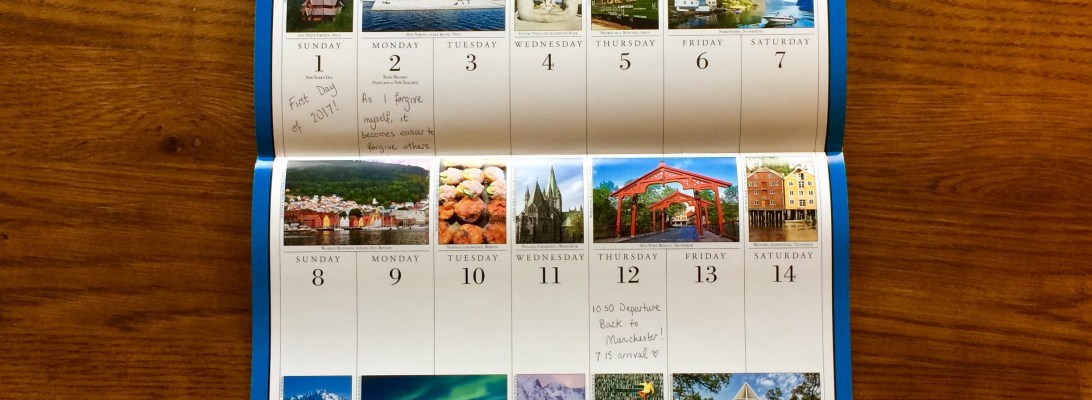
My January affirmation is: “As I forgive myself, it becomes easier to forgive others. I move beyond forgiveness to understanding and I have compassion and kindness for all.

I set really high standards for myself which isn’t very productive as I’m often left feeling bad about what I’ve accomplished because I always feel like I could do/be/have more. Also I feel like I sometimes reflect my standards for myself on to other people, expecting them to also strive for the same things. So my affirmation is designed to help me let go of constantly needing perfection in my life, and just to live and let live a little more.

Good luck in 2017 🙂