(A post written for the Mancunion – The Manchester Uni student newspaper).
Definition: someone who is interested in exploring veganism and experimenting with vegetables in new ways, but not quite ready to commit.
Been having some affectionate thoughts about vegetables lately? Perhaps you’ve been wondering about alternative sources of protein but you’re not quite ready to talk about it with your mates? You might be what experts are calling ‘vegcurious’.
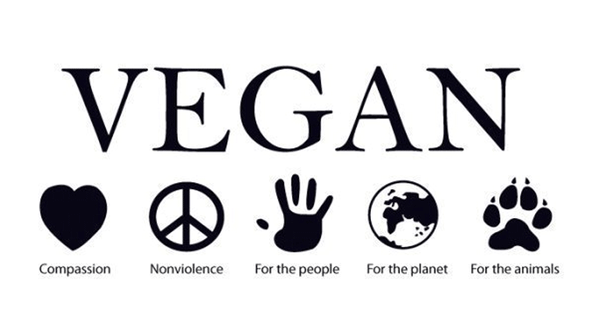
In the UK, over half a million people are completely vegan, almost 2 million are vegetarian and new figures are showing that many more people are vegcurious and want to know more about this plant-based lifestyle. In the US, the figures are even higher, and a staggering 40% of the population in India follow a vegan or vegetarian lifestyle. Veganism is drifting into the mainstream as research is showing that going vegan is a win, win, win situation. Good for the animals, good for the planet, and good for us.
Animal welfare and ethicality is of course still a really important issue, however it’s no longer the most popular reason for going vegan. Veganism is becoming as much an environmental cause as it is an animal welfare cause. Agricultural studies show that rearing cattle for food is the main effector of deforestation and has the biggest impact on global warming. A common misconception is that soy bean plants are causing deforestation, however 85% of these plants are used as feed for cattle and not human consumption, and therefore are also a part of the animal-product industry. Many of you will have heard the devastating news about the Great Barrier Reef last year caused by overfishing and global warming; moreover, the planets rapidly decreasing biodiversity is being dubbed by experts as the 6th extinction crisis. I think it’s time humans took responsibility for the harm we’ve caused, take a long hard look at the evidence and realise that it is the production of animal products for food which is exerting the greatest damage in our environmental crises.
If you’re not much of an environmental activist, that’s fine. But surely you care about yourself? Your health? With the popularity of veganism growing, so has the demand for scientific studies identifying the effect of this diet on your body, and whether or not a plant-based diet is able to provide adequate nutrient acquisition. The results are astounding, and show that not only is a vegan diet adequate, but it also decreases your risks of getting various diseases including different forms of cancer, obesity, cardiovascular disease and even osteoporosis. However, the risk of certain deficiency’s are higher in vegans because most people were never taught how to eat a well-balanced, vegan diet and therefore miss out key macro and micronutrients, and it’s important to transition your body safely into this new lifestyle as it is quite a drastic change in diet if you’ve always been a meat eater.
So if you’re a transitioning vegan or a conscientious meat-eater, make sure you’re filling your plate with balanced, nutritious foods that are going to supply you with the complete repertoire of nutrients your body needs. And try and be a little friendlier to vegetables.
Do I still love them? Yes, they’re pretty and yummy.
This post is about increasing awareness rather than personally condemning everyone that drinks (myself included) and just hopefully inspiring people to ask a few more questions and take the issue a little bit more seriously.
One quick comment before I bombard you with scary facts: it can be really hard in life to get it all right and be healthy all the time, and I’m not saying you should be all at once, it’s a process. We’re all under so much pressure in this world already without feeling like we can’t enjoy simple pleasures and let loose every so often. It’s important to not feel deprived and to make fulfilling choices that feel good. I personally am working towards a mental state where I feel great about making the healthiest choice, and it’s a really exciting journey. I’m writing this post to inform you, and with some hope that the next time you face a choice about how much to drink, there will be a little voice in your head that thinks of your liver and says, ‘ooh maybe I shouldn’t have that 3rd shot of tequila’.
Alcohol is, unfortunately, one of the biggest killers in the world, sorry, but it’s true. Alcohol abuse is embedded into our society to such an extent that most people wouldn’t go to social occasions or music events etc. if they weren’t going to drink. Decreased inhibitions, questionable decisions and ‘hilarious’ displays of clumsiness (aka your brain shutting down) seem to be the only way that we can go out, enjoy ourselves and fit in.
I am by no means tee-total or have any desire to become so while I’m still at university, but it’s something I’d really like to be by the time I’m 30 – I figure/hope that most of the damage can be undone (or at least slightly repaired) while I’m still young. And yes, 30 is still young.
I’m writing a Lab Report on the ‘Effects of Ethanol on Performance’ and subsequently have done a lot of research to find out what exactly ethanol does when it enters our body. My research has included reading other lab reports, medical reviews and reports done by the World Health Organisation and Public Health England, and also stuff I learn at Uni.
The first thing that shocked me was the amount of evidence proving how bad alcohol is for you and the fact that it is a misconception that a little bit is good for you. No alcohol is good for you. Period. What’s good for you is the other nutrients in the drink e.g. antioxidants in wine, yeast in beer etc. When mainstream attitude to smoking changed around 2005/2006, the government ruled that all smoking products must have visual and written warnings of its harmful effects, but alcohol kills more people than cigarettes do! Where are the pictures showing brain damage and rotting livers on alcoholic drinks? The list of potential poor decisions and the consequences of emotional and psychological trauma. I know this has turned heavy pretty quick, but we all know someone who’s life has been ruined by alcohol.
Annually, alcohol abuse costs the total British economy £21bn and the NHS £3.5bn. If our nation was so desperate to improve the economy and save our NHS, we should have all stopped drinking, not quit one of the most successful Unions in the world. England and the USA are among the top 20 heaviest drinkers in the world and all of the top 10 countries are in Europe (Global Status Report on Alcohol and Health in 2014).
Alcohol is a Central Nervous System (CNS) depressant. Your CNS is made up of your brain and spinal cord and controls most functions in your body and mind. Ethanol (the alcoholic component of drinks) depresses the CNS; in other words, slows it down and stops it from working. Ethanol acts on various receptors in the brain in order to increase inhibitory signals and decrease excitatory signals: this results in decreased motor (movement) functions, confused thoughts, decreased awareness and poor coordination. It also interferes with your ability to lay down memories and to learn by blocking specific signalling pathways and decreasing the actions of neurotransmitters (Glutamate) in specific parts of the brain (hippocampus, amygdala and striatum). You’re all thinking, “well yes we know all that!” “I frequently wake up with no recollection of the night before.” “My friend was throwing up all night last week, it was hilarious.” Why? Why is it funny to see people poison themselves to the point where their body has to reject everything in their stomach so their organs don’t shut down?
Prolonged drinking causes irreparable damage in the brain, destroys your liver and diminishes your immune system. Short-term drinking decreases the effects of your immune system, making you much more likely to contract a virus or bacterial infection after a night out; and long-term drinking increases the immune system, causing inflammatory diseases and internal damage. Alcohol is commonly known to be bad for people with digestive disorders including IBS and interferes with a lot of medications.
Quick fact: the reason people with less body fat get drunk quicker is because alcohol is very soluble in water but not soluble in fat. So if you have more fat cells in your body, alcohol is less likely to pass out of your blood, and will head straight to the liver to get broken down. It also makes sense that if you’re a bigger/taller person, there’s more blood for alcohol to get absorbed into, thus the concentration of ethanol at any one point in your body will be less.
I understand that it is very important for people to belong in their society and to fit in with cultural norms, evolutionary speaking this was essential for our survival, and social drinking is a part of that. I’m not writing this to try and convince everybody to stop drinking and boycott all bars and nightclubs, I’m writing this just to draw your attention to it. The next time your friend chooses not to drink on a night out, respect that decision. If you see your friend about to cross the line between drunk and smashed, give them a glass of water. Value yourself sober. Your sober self is good enough, fun enough and happy enough. And if you turn to drink to escape life, have a good look at what you’re escaping from and try and fix that instead, rather than just forgetting it for a night.
Albert Schloss Espresso Martini
I am a big believer in moderation, balance and self-awareness. Doing what works for you is the most important thing, and it’s vital that you pay attention to yourself and your body so that you can recognise if and when drinking becomes a real problem in your life. Drink to enjoy, not to forget.
My last message will be this:
Be safe, be aware, be kind to yourself and to others.


 Sophie Victoria Manley