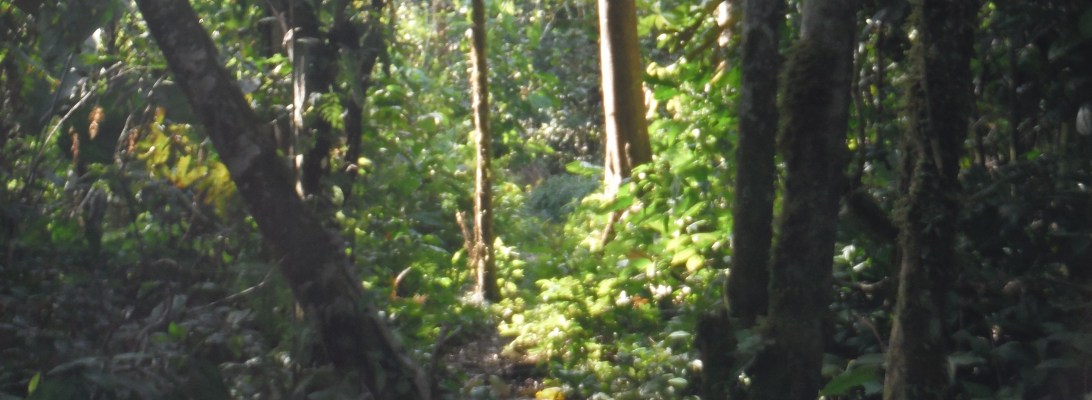
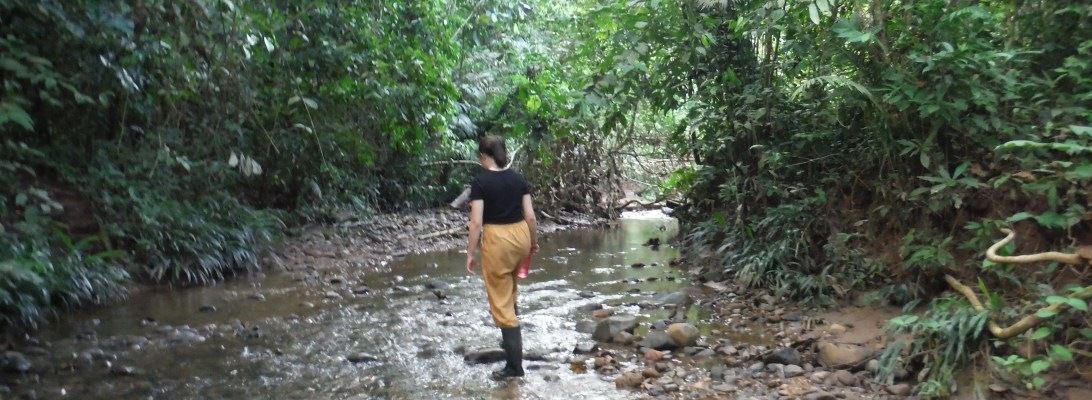
This morning, a guide, Javier and myself set out into the forest to set up my project. I need 12 transects (straight lines that I use to mark where I will collect my data) in both primary and secondary forest. We found suitable areas with plenty of space and started to set these up, however, we happened upon an unusual obstacle. The community believe that when a woman is on her period, she has witchcraft that destroys their land and crops. So as we were walking through the forest with our string and measuring tape, we kept accidentally finding ourselves in bits of farmland that were completely off limits to me, a woman with magic crop-destroying periods. Not a problem I thought I’d have to deal with, frankly.
I want to preface this post with a reality check: We live in the rainforest, in Ecuador, near an Indigenous Community, at a research station, on a river bank, in wooden huts, without a car, without a boat (more importantly), with just each other, in the jungle. Like if you saw our location on a map it would just be a dot in the green bit that covers some of the East of Ecuador. This place is isolated. To get to the nearest town which is a very basic, very small, very local little place takes 3 hours. To get to the nearest town with a bar takes 4 and a half hours. To get to the nearest town with English speakers takes 9 hours. To get to a city takes 14 hours.
In my opinion, that is fucking cool. We are separated from civilisation (apart from through the internet of course – thank god for the internet), out in nature, surrounded by beautiful wildlife, cooking from scratch, doing ‘science’, living a life (almost) free of social pressures and expectations and best of all living and working closely with a community of people who are from a completely different (metaphorical) world to us. It’s fascinating…
But wow! Does it get boring. It is effectively our job to run and maintain the station, that requires being here 24/7 funnily enough: in this small little patch of land, with a finite amount of things to do and people to talk to; for days, and sometimes weeks on end. Also, now we’ve started our projects we are tied to the station for at least 2 or 3 days a week to collect our data from the forest, there is 0 flexibility here so that our projects are valid and our results usable. And like I explained in paragraph 1, it takes a hell of a long time to get anywhere from here. There’s no ‘popping out’ from the station. No, no. There’s ‘right we have an appointment in Tena at 9:30am on Thursday for 20 minutes so we’ll need to leave 2 days in advance and we’ll be away from the station for 4 days okay let’s pack up every single item in the whole station so the community can’t steal anything, umm order a canoe a few days in advance, pack a weeks worth of laundry and clothes, book accommodation, write a shopping list and then yeah, good to go’. So, as you can (hopefully) see, unless we have a visa office to visit or a document to retrieve, we are stuck here.
Most of the time I think I have more freedom here than anywhere else in the world. I can get up when I like, I have enough time to read books, watch movies, eat leisurely and work at my own pace. I don’t have a myriad of lectures, meetings, shifts, matches, events that lead my life for me; I lead my life here, not the timetable on my outlook calendar. But sometimes I feel caged in and bored. Bored bored bored. And when I get bored I get tired, which just perpetuates this boredom cycle and I loose motivation and sometimes when it gets really bad, I loose touch with reality a little.
I don’t mean to undermine the life we have here (I actually think sadness and challenge augment our reality as we learn and grow through these hard experiences) but understandably we get a bit stir crazy every so often! This manifests in many different ways, some weirder than others, I won’t go into details. We haven’t yet had the time to take a holiday in Ecuador and go and have some fun. Every time we’ve left the station previously it was on visa or food related errands which are crazy-frustrating and boring, in that order. I think Heather and I deserve some real credit here, for all intents and purposes we are managing extremely well under the circumstances. We chose this placement in the first place (separately) knowing it would be challenging and isolated, so we also knew ourselves well enough to know we would probably be fine with it. Which we are *insert earnest smile*. However… we really ought to get out more.
Which we will: back-at-the-station-after-christmas resolution number 1 was to take some time off ‘work’ (go on holiday) every month; and Heathers 21st birthday is fast approaching so we are taking our first fun trip in Ecuador and going to Banos (Ban-yos – Baths in Spanish because the town is built on the side of the tallest volcano in Ecuador and there are lots of thermal baths there) for 6 days which will be mega fun. Lots of canyoning, hiking, rafting, zip-lining and thermal-bath bathing in Banos. We leave this Friday and will shun all responsibility until we get back the following Thursday, and it’ll be great. We will come back renewed and full of life, I’m sure.
Anyway, the day is running out and I’m actually procrastinating a little right now – I should be reading Fungi Biodiversity papers.
So, signing off – from the hammock near the wifi router, wooden hut, river bank, Payamino, Ecuador.
It’s a quiet day at the station today. Only Heather and I are here so we have complete freedom to do what we like when we like. This freedom only really extends to when we eat, usually with more people at the station mealtimes are regular and we take it in turns to cook each meal, but with only the two of us here, I ate breakfast at midday and Heather ate lunch at 3: we’ve descended into madness. Apart from that, we are still at the mercy of the weather and can’t leave the station as we have work to do here. It’s been raining the last couple of days so wifi and power have been a little dodgy, and until recently the station has been relatively full! So it’s back to our quiet little life.
Life has taken a few turns recently, ebbing and flowing like the tides of El Rio Payamino. It’s easy to see a surface view of someone’s life and assume that all’s fine and dandy, but actually there’s usually something going on there which doesn’t breach social media or light conversation.
My life has been a bit up and down recently. I think being ill always gets you down and it takes a little while to regain the swing of things; I’m still not better after my ear infection which is making me a little lethargic and foggy. Another thing – this one took me a while to figure out on all my travels – but it turns out you’re not immune to insecurities / down days / mad panics about life just because you live somewhere cool: had a few of them recently. Also, the direction of my project has changed once again. It’s been a real challenge figuring out what kind of research is available in the field, balancing my highly-optimistic research aims, and evaluating my own limitations in order to find the middle ground of what’s actually doable here.
It was quite disheartening at first, but I am a fan of silver linings and have started to appreciate the benefits of my new plan. It will be a lot simpler and easier, I will have more control over every aspect, and the write-up will be more straight forward. All boring things, I’ve lost interest over ease, but at least I can actually make a start.
Field work is surprisingly slow. There are a lot of social, political, meteorological and ecological hoops to jump through that you just don’t expect to meet when you set out on your journey, hoping to uncover some valuable resource or hidden knowledge. And field work is clumsy. Of course we adhere to ‘the scientific method’, and keep all our data as valid and reliable as possible, but at the end of the day, research is limited by the people doing it and the amount of money and time they have. We’ve recently been collecting data for an arachnid biodiversity study which sounds to me awfully professional and serious, but the actual field work/data collection side of things juxtaposes this scientific vision of serious, intelligent people doing serious, intelligent things, and replaces it with a group of people, some scientists, some undergrads, and some indigenous community members, literally catching spiders in the jungle. There’s more to it than that, years and years of research that has cultivated the perfect method and most accurate data analysis, however the literal translation from the methods section in a scientific paper to people working in the field is not what you expect. It’s been fascinating to learn this and experience some real life science in the field.
All in all life at the station has been great. The company has been wonderful, and it’s nice to be back home in our idyllic, little corner of the world. But I’d be lying if I said life has been perfect: life has been normal, I guess, but still full of discovery, new experiences, learning and getting shit done, which are the main things, I think.
I have arrived in Ecuador safe and sound, sorry to say bye to England but excited to settle back into my Ecuadorian life! Goodbyes were quite hard this time, and it was tougher than usual to tear myself away from my family and friends, but the further from home I travelled, the more I started to look forward and the easier it became to leave my comfort zone behind. My journey to Ecuador was long and comprised of: a car, boat, bus, train, coach, bus, Travelodge, bus, plane, plane and finally taxi and took 35 hours. Definitely not the longest journey I’ve been on, but exhausting never-the-less!
Getting through Quito airport was a little tricky… they have 2 security checks, each one before and after baggage claim, and I got questioned a lot over my visa situation! I only have another 9 days left on my tourist visa: I’ve applied for a work visa but Ecuador is THE SLOWEST COUNTRY EVER and it’s taken months and I haven’t heard from the visa office at all. So I got a little warning upon entry and was told I must leave after 9 days. When we were applying for work visas, it wasn’t a case of just filling out a form online and sending a couple of emails, because in Ecuador, they don’t reply to emails. (What!??) So you have to SHOW UP everywhere. And these visa offices and universities aren’t near each other – on average they are probably about a 6 hour coach journey from each other. So ‘getting our visas’ translates into zig zagging up and down the country, having meetings and showing our faces so we can pressure them into moving forward in our applications (mine and Heathers). So anyway I got through security with a warning I have no intention of taking seriously, then we teamed up with another traveller to get a taxi to the old town in Quito where we’re staying.
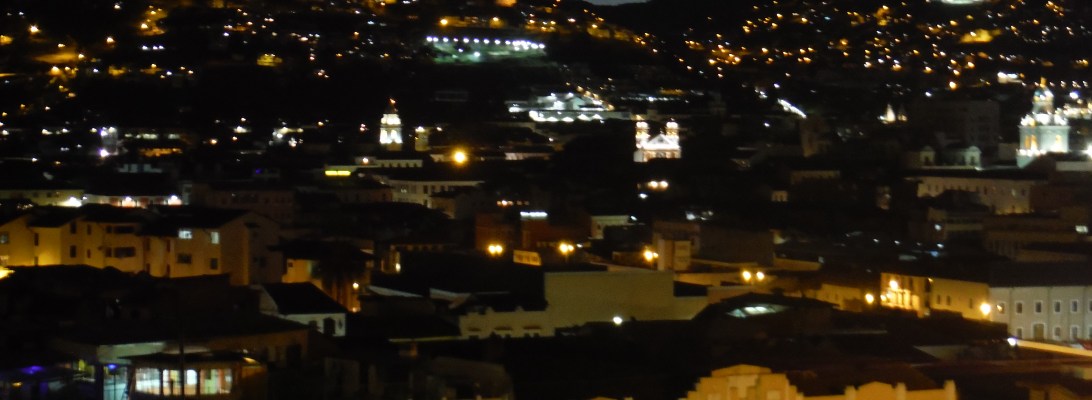
One thing that struck me when I arrived was how familiar Quito feels to me now. It’s a joy to get to know a place and feel safe there, especially when it comes to logistical things; like knowing if a taxi is taking you in the wrong direction and if they are over-charging you! Also, it was an absolute joy to arrive in Ecuador and have enough of a grasp of Spanish that I can communicate with the locals – it makes life so much easier! And I think it’s such a special thing: being able to speak more than one language, it gives you such an insight into other cultures! I’m always so curious when I hear people speaking a different language, I would love to know what they’re saying! It seems so mysterious when you can’t understand, but I bet most of the time it’s just the usual mundane, boring stuff we talk about in English! Speaking all the languages in the world is in my top 3 most-wanted super powers. So being able to understand Spanish is so exciting for me. I’m no expert, but I get by and I am trying to get better all the time.
Another beautiful thing about being back in Ecuador is the music. I was surprised to learn that Spanish music has heavily infiltrated the UK charts when I was home over Christmas, and lots of the songs I cherished as being a part of my South American journey were actually quite well known in England! But I will always associate those songs with Ecuador: the places I’ve been here, the journeys I’ve done, the bars I’ve danced in, the hostels I’ve stayed in. And that is quite magical. Although, true South American music is quite different to Spanish chart music. It’s the more traditional salsa and flamenco that you’ll find playing in local, less touristy areas!
Last night Heather and I went out for a few drinks and we started the night at another Hostel called Minka. We were informed by the staff at our hostel who were also going that it is a bit of a party hostel. When we arrived, however, we weren’t particularly enthused because it was really quiet and there were even 2 guys asleep on the sofas! But we joined a little group outside eating, drinking and smoking and started to have fun and eventually, unsurprisingly, a guitar somehow made its way to the table! A quite accomplished Colombian guy and his girlfriend then proceeded to play a bunch of Latin American songs, harmonising and with a shaker might I add – definitely rehearsed for moments like these, and most of the table were singing along. Now, I know that travelling guitar players have a bit of a bad rep among the British, but I genuinely think it’s because we’re not as open to it, and also there are definitely a few douchebags who ruin it for the whole lot. Unsolicited guitar playing while everyone is quite happily chatting is definitely a dick move, but a group sing-song with a good player and a few beers is actually a really great thing. I actually fall into this group of travelling guitar players so I may be a little biased, but I’m just as happy to sit back and listen as I am to take centre stage. Last night was a bit of both, we spent the first couple of hours soaking in the culture of the passionate South Americans and their fiery music, and by the end of the evening I had a guitar in my hands and was serenading the whole group with I’m Yours and Somewhere over the Rainbow… and I unapologetically loved it.
One of my resolutions in Ecuador is to properly learn a Spanish song by the end of the year! Then I’ll be a real dick when I travel haha, not only playing the guitar and singing, but in another language too. Don’t hate me too much.
So right now I am in my hostel, hungover but feeling really satisfied and comfortable. We chose to stay in Hostel Revolution this time, which is more quiet, because it has a kitchen – a real must for travellers on a budget (which unfortunately is me). It’s nice enough, not as good as Secret Garden but the kitchen has been SO worth it!!
Side note: if anyone is thinking of going travelling, bring a towel dressing gown. It is one of my FAVOURITE things. You avoid the awkwardness of walking around in a towel and its really easy to get changed under – little travel tip. Also!! Second travel tip: Lush shampoo’s and conditioners are AMAZING. They are completely vegan and bio-degradable which is obviously fantastic, but they come in these little bars which sit neatly in a little tub, so super easy to transport and they last for ages!! I washed my hair for the first time with them today and my hair looks really great, so massive advocate for Lush right now!
Today the weather in Quito is 15 degrees-ish which is pretty perfect for a life admin / movie day in bed. So that is exactly what I’m doing!
It’s a Friday afternoon, 6pm, pitch black outside, and I’m cosying up on my sofa with a couple of candles lit and gentle music in the background. I’m feeling quite sorry for myself today because a light cold that started just before New Years has recently turned into a horrible cough after a couple of nights drinking and subsequent poor sleep, and I’m on my period. So taking it pretty easy today. Drinking herbal tea and trying to eat healthily while craving nothing but sugar (in the form of chocolate and ice cream).
Despite all that, I’ve actually had a pretty good day. In the morning me and mum went to a fitness class (the first proper exercise I’ve done in about 4 months) and then I went for a coffee with a group of people I met last night at a Neuro-Linguistic-Programming seminar. It was led by a man named Paul Cosen (who is based in Canary Wharf) and was an introduction to NLP, organised by Sarah Brown, who is a holistic therapist (based on the Isle of Wight). I am, of course, really interested in all types of therapies and my dad is an NLP practitioner although he doesn’t actually run sessions, he completed a course more for his own emotional journey and to use the therapeutic tools in his own life.
I arrived at the seminar not knowing what to expect, and also not knowing much about what NLP is or has to offer and I’ve come away from it with a vaguely solid idea, and with the intention to book a session for myself at some point over the next couple of years. My impression is that it is a holistic amalgamation of many different (mainly) non-verbal, sensory therapies that aim to assist the mind in processing traumatic events in the past in order to move forward in a healthier, happier way. More of a mind map or toolkit with lots of techniques and exercises at a practitioners disposal, rather than a structured one-fits-all method.
The seminar started interactively with Paul getting a feel for what we wanted out of it. The general consensus was that we wanted tools for personal use, to help overcome obstacles in our lives. I didn’t speak too much as I’m not that comfortable speaking in a big group. I actually prefer one-on-one chat. Any more than a small group and I tend to sit back and stay quiet. It’s not a lack of confidence, it’s more about the fact that I do enjoy listening and learning, I don’t feel the need to share what I think with everyone (unless I have a burning question) and I really don’t like fighting to make myself heard, working to be the first and loudest when the conversation pauses in order to make my point. So consequently I don’t say much. If I had, I would have said that I wanted tools in order to get over some traumatic events in my past because I’m not over them and they affect my life on an almost daily basis. I think that a lot of issues that people have boil down to fear: fear of failure, lack of confidence, a phobia, fear of humiliation, fear of judgement etc. and I think that my main fears are of my own emotions and of people/vulnerability. I’m a very empathetic person and my emotions run strong and deep; and because I had quite a tough time growing up they just became absolutely unbearable. So for the last 3 or 4 years I’ve been slowly repressing as much angst and pain as I possibly can. I’m now so adept at it that I barely feel sad and depressed any more at all which is great, but it’s also made me slightly apathetic and unemotional, and it’s taken away my happiness too. I didn’t really notice this until I was asked by someone, when is the last time you felt real happiness? and I couldn’t remember. Not for years, I thought. I’ve just been numbly ticking along, getting shit done, sure, but not really enjoying my life. And I’m now at a point where I’m ready to move on, and have the strength to do that. For the first time in my life I have a network of people close to me that I can truly trust and rely on, and I feel safe and healthy. But that’s not something you can put into a couple of words in an interactive group session, so I mostly stayed quiet.
At the end of the seminar however I was selected to take part in an exercise called The Orgasmic Chair. Me and this other lady sat back to back and were asked to give three words that described what we wanted more of in life. My words were: happiness, love and self-acceptance. I thought they seemed pretty cliche but they were genuine and things that I’ve wanted more of for a long time now. The lady behind me said: confidence, self-belief and fun. Then we were told to close our eyes and the rest of the group walked around us in a circle saying really positive, beautiful messages using the words we had given them. Some of the women stroked our arms and our heads, and some just spoke, but the whole experience was uplifting, freeing and really quite soothing. Having been single for a long time and away from home, I don’t have much affection or intimacy in my life, so it was actually really nice to experience this brief but powerful deluge of warmth and tenderness. So rather than sexual pleasure, The Orgasmic Chair filled me with a sense of love and of being loved, which I really needed.
Then today during our coffee we had the chance to have more of an open conversation. I was able to share some of my story and receive some answers to the questions that I had which was really nice. Also Paul did a few exercises with me in order to work through particular traumatic memories: I hope it’s worked. So a really positive experience overall and I’m so glad I went! It takes a little to put yourself out there and go with an open mind, but I felt a real connection with the group and definitely plan on going to more events like these on the island, and off, in the future! I also met a women who’s going to put me in touch with her son who has studied indigenous communities in Ecuador, and is now studying fungi in Spain… very very strange coincidence! (To learn more about what I’m doing in Ecuador, read this post: Why We’re Here – The Research).
So in conclusion! Very successful day for my emotional journey. Feel like I’m actually getting somewhere I want to be and know how to keep going.
For those of you who have got the impression that so far my time in Ecuador has mostly been exploring, lying in a hammock and swimming, you’re wrong. Well, half wrong. Okay, just a little bit wrong, we have been doing a lot of that. But there’s a much more serious side to our life here: the research.
To preface the bulk of this post, I’ll just explain why I’m here: I’m 2 and a bit years into a degree in Biomedical Sciences with Industrial Placement at Manchester, and this is my placement. Heather is also on placement with me, she studies Zoology at Manchester and is a passionate animal lover, even the grizzly, scary, creepy ones… especially the grizzly, scary, creepy ones. Our aim over the course of this year in the Jungle is to complete research in an area of our choosing and produce scientifically viable results. If we work hard, then getting published could be on the cards.
We’ve both spent a long time coming up with a plan for our research proposals which mainly involved a lot of emailing, scrolling through PubMed, reading papers and chatting to Javier, the Ecuadorian station manager, about what would be possible. Javier has a degree in Forestry Engineering and has been working at the station for 6 years now. He’s affectionately nicknamed Jungle Dad and is sociable, generous, and a real joker. Even though most of his jokes are in Spanish and fly straight over our heads, he still makes us laugh with his faux-stern expressions, dad dancing and inability to say slept. “Slepech. Slepecha. Slepch?”
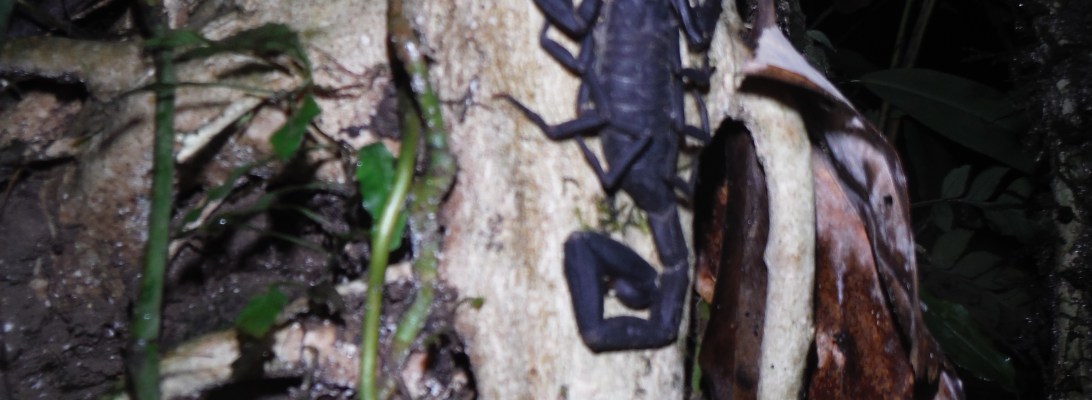
Heather’s main project will be investigating the Arachnid biodiversity here at Payamino. She was given a fantastic opportunity to work closely with an Arachnid specialist during her time here; they’ll complete the field work and research when he arrives at the station in January next year. ‘Arachnid Biodiversity Study’ means capturing as many spiders as possible, bringing them back to the station and identifying what species they are. Heather’s hoping to gain a greater appreciation of an animal that’s normally shunned in society and has a huge fear stigma attached to them. In her opinion, they’re actually underappreciated, beautiful creatures that aren’t nearly as scary as they seem. Already we’ve seen lots of spiders, including a baby tarantula (that we caught in a soup bowl) and many jumping spiders. Heather uses the word adorable, not something synonymous with spiders in my personal opinion, but it’s her project not mine. It’s a good thing I’m not scared of spiders (which my mother proudly attributes all credit to herself as she always made me and my sister get rid of the spiders in the house so she didn’t have to, thanks mum). Also, Heather will be continuing with the research on Heliconias, a native flowering plant, which was started by a previous placement student. The project is looking at the effects of genetic variation in Heliconia species and the associated insect communities. It will involve cutting off roots from existing plants and growing her own little, genetically-identical garden, then measuring the species diversity found between the two plants. Interesting stuff, plus Heliconias are really pretty.
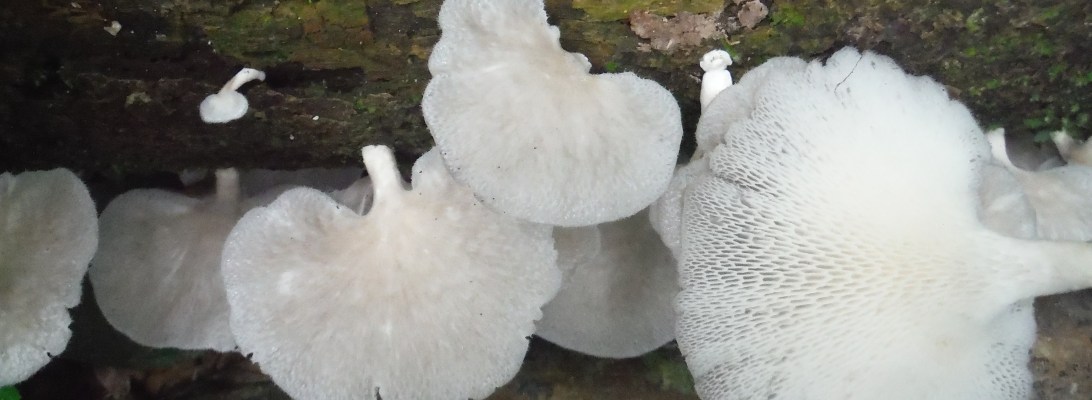
My projects, which I’m very excited about, will be Fungi Biodiversity and knowledge about ethno-medicine in indigenous communities. Fungi are a largely under-researched, under-appreciated group of organisms. They are neither a plant nor an animal, but a whole kingdom to themselves. My project will be on the different types of flowering fungi found in Payamino. It will be impossible to do an all-inclusive biodiversity survey as a lot of fungal species are microscopic and I just don’t have the equipment to find them, so the project will be limited to fungi I can see with my eyes. There has been absolutely zero research into fungi biodiversity here, so I’m in unchartered territory and hopefully my research will be valuable to the scientific community. Once I’ve collected data on each fungi I find, I will get in touch with a fungi specialist either in Quito or the UK who can help me identify each species. Hopefully I’ll develop a comprehensive list of species found in this area. My interest in fungi started to develop in first year of Uni when I came to appreciate how diverse, interesting and spectacular they can be. For example, did you know that some species of fungi create their own jets of air in order to spread their spores further; some species are carnivorous, capable of punching holes in the cell walls of passing nematode worms and insects for food; and some have even teamed up with plants they live on and kill the insects for them then feed them the corpses. I started to see them as the research underdog of the natural world, and love the idea of contributing to this hugely unfinished puzzle piece of nature.
My second research project is quite close to my heart. I’ve always been interested in alternative medicine and how they practice medicine in different parts of the world, inspired by my own battle with illness, and had the idea of looking into medicine used in the indigenous communities here before I even applied for the placement. When I arrived, I found a book on the book shelf entitled ‘Plantas de Medicinales en Payamino’. I’m sure you can crack that Spanish on your own. The book was a catalogue of all the different plants used medicinally by the Kichua community, what they’re used for and how they’re prepared. I got in touch with the author of the book, Dr Brian Doyle – a researcher in the States, asking if there was any further research he wanted to do here, and if not, whether his research bought up some interesting questions that I could research myself. He replied with 3 large bullet points, each detailing a possible research area I could pursue, and said he was planning on coming back to Payamino next year to continue his research. This was the best possible news I could have hoped for. Bullet point number 1 turned out to be not so relevant after chatting with Javier who knows the area and communities really well. Bullet point number 2 was simply monitoring all the plant species year round; collecting samples for the National Herbarium in Quito and collecting data and pictures about the life cycle of each plant. Bullet point number 3 was by far the most interesting and challenging suggestion. Brian had recently published a paper that analysed the distribution of knowledge about traditional medicine across the community near the station. His suggestion was that I do the same thing, with improvements and a few alterations, in a few other indigenous communities, and use the data to compare knowledge between communities. Imagine: travelling to various indigenous communities in the rainforest, staying for a week or so and in that time surveying a random sample of the population using images of plants and a basic questionnaire. Queue huge excitement and the stomach-dropping realisation that I’m going to have to be near fluent in Spanish to pull this off. So at the moment I am doing my best to learn Spanish, with a general plan to do this field work next Easter.
So my plan is to get a chunk of the Fungi project done by Christmas and send over the data to a specialist to see what results I get; and learn Spanish rapido. There’s only so far you can get with audio-tapes, books and Duolingo, so Heather and I spent an intense week in el Coca having Spanish lessons with an Ecuadorian-but-lived-in-Norway-for-18-years English teacher, Fernando, doing 4 hours of lessons a day. It was a pretty hard week but we learnt a lot. On the Friday, we went to a bar (Papa Dance, a salsa bar on the river) with Fernando and met some of his other students learning English and found we could actually have a simple conversation and swap basic information about our lives. It was a triumphant moment.
The pace of life is still quite slow here as we travel to and from various cities on a weekly basis to get all the relevant documentation needed for our contracts with UEA and our Ecuadorian work visa, and as we adjust to the living conditions in the Rainforest. We’ve only been here a month but it already feels like a lifetime. This little clearing on the bank of el Rio Payamino has become our home and we love it. We both have high hopes for our research here and can’t wait to see our ideas and plans come to fruition. Let’s hope that in a year’s time, Heather and I can look back at the blog post and have succeeded in meeting our aims. Buena suerte a nosotros. Good luck to us.
Travelling on your own can be a daunting and even seemingly impossible prospect. Glorified blogs and epic Instagram accounts make it seem like only the most accomplished travellers dare to wander the world independently, risking their lives everyday and partying with new people every night. These travellers usually have expensive GoPro’s and movie editing software, endless streams of money and a seemingly innate ability to talk to anyone.
However, from my own experience, I can tell you that it’s not as glamorous and scary as it seems. Most solo travellers are people who decided to set off on a path of self-discovery, step out of their comfort zone, take a few risks and ended up accidentally on a whirlwind adventure. The trick to travelling is to keep putting one foot in front of the other. No matter where you end up, who you meet, what you loose, what you find… just keep moving forward and don’t give up. You will learn how to make the next step after you’ve taken the last. There are lots of ways to ease yourself into life on the road that will make you answer the question ‘how did you find travelling on your own?’ with a confident ‘I was never on my own’ when you get home from your adventure, full of pride and amazing memories.
Now you’re all inspired to organise your first solo journey, I’ll give you a few tips on how to get going. There are several ways to start your travels, but the main ways are working, volunteering, backpacking or couch-surfing.
WORKING. Do you want to get travelling now but just don’t have the cash saved? Work your way around the world and you’ll never have to stop. The beauty of being prepared to work is that you can keep going for as long as you like. Whenever you’re close to running out of money, put down some roots and get a job wherever you are at the time. Working holiday visa’s for 18 – 30 year old’s are pretty easy to get for Australia, New Zealand and Canada. Buy yourself a visa, book 1 week in a central, popular hostel in a city of your choice, catch a flight, and get job searching once you’re out there. Look on gumtree, pop into STA, hand out your CV, speak to people and keep your standards low. My first job in Sydney was door to door sales. I quit after a week but I ended up moving in with the people I met on the job (who also quit after a week) and we became really great friends. Alternatively, you could get a seasonal job. Popular winter seasonal jobs are Ski Seasons: getting these are as simple as googling, emailing and persevering. During summer, you could work in a bar/restaurant in a party town around Europe, to do this you’ll either need to go through an agency online, or just rock up and start handing out CV’s. If the drink all day and party all night life just isn’t for you, you could get a job as an activities leader. Camp America is great if you don’t need to save, or you could try In2Action who supply activity coordinators to Holiday Villages all around Europe (and 2 outside of Europe). I worked in Tunisia for 4 months and absolutely loved the experience! Another avenue you could go down is working on a cruise ship! Whether you’re an entertainer, singer, dancer, restaurant staff member or cleaner, you’ll be paid to tour some of the most beautiful places in the world. Another option for those of you who want to travel a bit more permanently, is to do a TEFL (Teach English as a Foreign Language) course. This enables you to teach in schools all over the world, earn a decent salary and really immerse yourself in a new culture.
VOLUNTEERING. If there’s something more specific you want to do, maybe this is the way forward. The International Citizen Service is a great place to start if you want to really make a difference in a small community by working on a project. Their website is very helpful and the great thing about ICS is that all you have to do is fund raise £800, and all other costs are paid for. Something I’m desperate to do once I’ve finished University is to volunteer at a Yoga and Surf retreat. These are found all over the world (I want to go to Sri Lanka!) and usually say if you work in a cafe/restaurant for free, then you have access to surf equipment and yoga classes at their facility. If you want to volunteer while on the move, you can work for bed and board. This includes WWOOFing, (a popular option in Australia) or working in a hostel, on reception or cleaning, in return for free accommodation.
BACKPACKING. There are so many organised tours out there, visit STA or have a google to find some of the most popular tours for solo travellers. These are great for the first couple of weeks as you usually end up meeting some people you can stick with once the tour is over, and they give you a good feel for a new country whilst keeping you totally safe. Down side is these are a little more expensive. If you don’t fancy a tour, just rock up to a new place having pre-booked a popular, suitable hostel and researched a bit about the area and what you want to do there, and start making friends! People are much friendlier in hostels than they are anywhere else in the world – I promise. If you’re more organised, then plan your journey and your accommodation in advance. If you’re more spontaneous (like me) and get a thrill from last minute decisions and not knowing where you’re going to end up, then just book the first few days and see where life takes you.
COUCH SURFING. This one is fairly self explanatory! Get signed up on the couch surfing website, build a profile, and plan your journey. The benefits of this mode of travel is that you get to hang out with locals who can point you in the direction of some hidden gems as well as the obvious tourist attractions. The downside is that you may feel a little bit vulnerable if you don’t feel comfortable staying in other peoples homes.
So hopefully you now feel equipped with a wealth of knowledge about how to plan and implement your solo travels. Good luck! Find yourself, loose yourself, take lots of selfies – and don’t be scared to ask strangers to take your picture!! – and take care.
Do I still love them? Yes, they’re pretty and yummy.
This post is about increasing awareness rather than personally condemning everyone that drinks (myself included) and just hopefully inspiring people to ask a few more questions and take the issue a little bit more seriously.
One quick comment before I bombard you with scary facts: it can be really hard in life to get it all right and be healthy all the time, and I’m not saying you should be all at once, it’s a process. We’re all under so much pressure in this world already without feeling like we can’t enjoy simple pleasures and let loose every so often. It’s important to not feel deprived and to make fulfilling choices that feel good. I personally am working towards a mental state where I feel great about making the healthiest choice, and it’s a really exciting journey. I’m writing this post to inform you, and with some hope that the next time you face a choice about how much to drink, there will be a little voice in your head that thinks of your liver and says, ‘ooh maybe I shouldn’t have that 3rd shot of tequila’.
Alcohol is, unfortunately, one of the biggest killers in the world, sorry, but it’s true. Alcohol abuse is embedded into our society to such an extent that most people wouldn’t go to social occasions or music events etc. if they weren’t going to drink. Decreased inhibitions, questionable decisions and ‘hilarious’ displays of clumsiness (aka your brain shutting down) seem to be the only way that we can go out, enjoy ourselves and fit in.
I am by no means tee-total or have any desire to become so while I’m still at university, but it’s something I’d really like to be by the time I’m 30 – I figure/hope that most of the damage can be undone (or at least slightly repaired) while I’m still young. And yes, 30 is still young.
I’m writing a Lab Report on the ‘Effects of Ethanol on Performance’ and subsequently have done a lot of research to find out what exactly ethanol does when it enters our body. My research has included reading other lab reports, medical reviews and reports done by the World Health Organisation and Public Health England, and also stuff I learn at Uni.
The first thing that shocked me was the amount of evidence proving how bad alcohol is for you and the fact that it is a misconception that a little bit is good for you. No alcohol is good for you. Period. What’s good for you is the other nutrients in the drink e.g. antioxidants in wine, yeast in beer etc. When mainstream attitude to smoking changed around 2005/2006, the government ruled that all smoking products must have visual and written warnings of its harmful effects, but alcohol kills more people than cigarettes do! Where are the pictures showing brain damage and rotting livers on alcoholic drinks? The list of potential poor decisions and the consequences of emotional and psychological trauma. I know this has turned heavy pretty quick, but we all know someone who’s life has been ruined by alcohol.
Annually, alcohol abuse costs the total British economy £21bn and the NHS £3.5bn. If our nation was so desperate to improve the economy and save our NHS, we should have all stopped drinking, not quit one of the most successful Unions in the world. England and the USA are among the top 20 heaviest drinkers in the world and all of the top 10 countries are in Europe (Global Status Report on Alcohol and Health in 2014).
Alcohol is a Central Nervous System (CNS) depressant. Your CNS is made up of your brain and spinal cord and controls most functions in your body and mind. Ethanol (the alcoholic component of drinks) depresses the CNS; in other words, slows it down and stops it from working. Ethanol acts on various receptors in the brain in order to increase inhibitory signals and decrease excitatory signals: this results in decreased motor (movement) functions, confused thoughts, decreased awareness and poor coordination. It also interferes with your ability to lay down memories and to learn by blocking specific signalling pathways and decreasing the actions of neurotransmitters (Glutamate) in specific parts of the brain (hippocampus, amygdala and striatum). You’re all thinking, “well yes we know all that!” “I frequently wake up with no recollection of the night before.” “My friend was throwing up all night last week, it was hilarious.” Why? Why is it funny to see people poison themselves to the point where their body has to reject everything in their stomach so their organs don’t shut down?
Prolonged drinking causes irreparable damage in the brain, destroys your liver and diminishes your immune system. Short-term drinking decreases the effects of your immune system, making you much more likely to contract a virus or bacterial infection after a night out; and long-term drinking increases the immune system, causing inflammatory diseases and internal damage. Alcohol is commonly known to be bad for people with digestive disorders including IBS and interferes with a lot of medications.
Quick fact: the reason people with less body fat get drunk quicker is because alcohol is very soluble in water but not soluble in fat. So if you have more fat cells in your body, alcohol is less likely to pass out of your blood, and will head straight to the liver to get broken down. It also makes sense that if you’re a bigger/taller person, there’s more blood for alcohol to get absorbed into, thus the concentration of ethanol at any one point in your body will be less.
I understand that it is very important for people to belong in their society and to fit in with cultural norms, evolutionary speaking this was essential for our survival, and social drinking is a part of that. I’m not writing this to try and convince everybody to stop drinking and boycott all bars and nightclubs, I’m writing this just to draw your attention to it. The next time your friend chooses not to drink on a night out, respect that decision. If you see your friend about to cross the line between drunk and smashed, give them a glass of water. Value yourself sober. Your sober self is good enough, fun enough and happy enough. And if you turn to drink to escape life, have a good look at what you’re escaping from and try and fix that instead, rather than just forgetting it for a night.
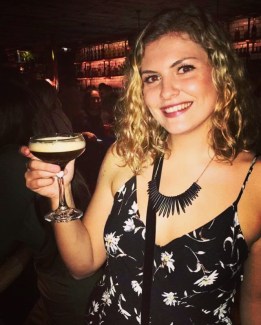
Albert Schloss Espresso Martini
I am a big believer in moderation, balance and self-awareness. Doing what works for you is the most important thing, and it’s vital that you pay attention to yourself and your body so that you can recognise if and when drinking becomes a real problem in your life. Drink to enjoy, not to forget.
My last message will be this:
Be safe, be aware, be kind to yourself and to others.

 Sophie Victoria Manley