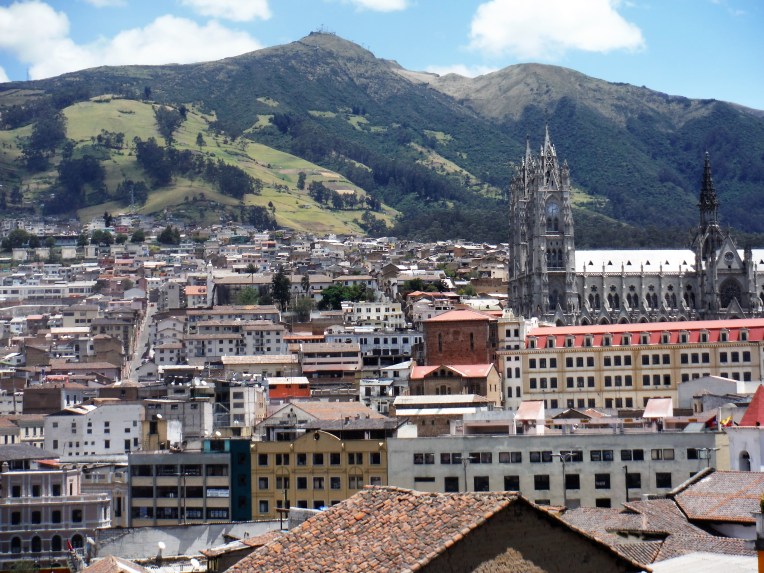
Did you know that the capital city of Ecuador, Quito, is the ‘highest’ capital city in the world? (but only when Sucre is considered capital of Bolivia, if it’s not then technically La Paz in Bolivia is higher) sitting at 9,350ft (2,850m) above sea level. Altitude sickness is a real danger in Quito, and unfortunately I found this out the hard way after drinking on my first night in Ecuador. I didn’t overdo it on the night out so when I woke up on deaths door, unable to keep anything in my stomach the whole day, I was totally confused and convinced I had contracted some awful stomach bug, but after talking to some of the volunteers at the hostel, it turned out that this was actually completely normal, and that it was the altitude at fault, and not some nasty Ecuadorian disease.
Unfortunately, I never seemed to recover from altitude sickness and spent the whole week feeling nauseous and fatigued which was slightly inconvenient. Couple that with being vegan and finding it semi-difficult to get proper meals, I ended up feeling a bit weak and malnourished by the end of the week. Saying that, being vegan wasn’t too difficult and I did manage to eat out and not starve. So day number 2 was a complete write off: caught up on GoT and watched The Angry Birds Movie in bed feeling really sorry for myself. Even traversing the many stairs in the hostel proved too much for my fragile stomach so I was pretty much confined to my bed all day.
I had gone out with some people I met at the hostel as well as Amy who had just done 3 months at the research station as part of her masters’ project and was staying at The Secret Garden on her way home. It was my first night in Ecuador and Amy’s first night out of the rainforest so she had a touch of cabin fever and a night out was the perfect remedy. Then on Tuesday, while I was dying in bed, Lucas arrived in my dorm and we became fast friends. We ended up exploring Quito’s old town the next day together which was pretty but was also very run down. Ecuador is famous for the chocolate they make here which is really good quality, and we discovered this shop which at first appears like just a door with its paint coming off, surrounded by traffic and pollution and other run down stores, but you step inside and enter this haven of quality, money and a lot of chocolate. We had coffee and cake in there, feeling rich for half an hour.


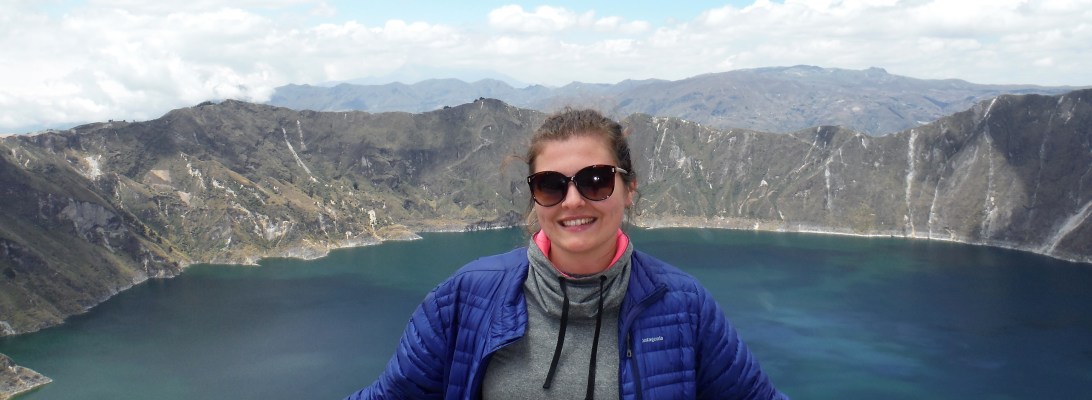
The next day (Thursday), Amy, Lucas and I went on a tour to the active, but dormant volcano, Quilatoa. We went via a Kichwa community which was amazing because they keep 100’s of Guinea pigs which are so, so cute and puppies which they were selling for $5. I so wanted a little Ecuadorian puppy during my stay here but knew, of course, that it would be stupidly irresponsible to get one. We learnt that the Guinea Pig is a speciality in Ecuador, and as live animals they are celebrated and well-cared for. Shamans claim that Guinea Pigs can be used to diagnose human illnesses better than Western Medical technology. It’s not a very nice method, but our tour guide swore by it, explaining that his dad was a Western Doctor and he had seen the Guinea Pig method live. The Shaman rubs the Guinea Pig all over the patients’ body, and then immediately cuts the Guinea Pig open, and the Guinea Pig will have become ill with the exact same thing that the human is. They use them to detect past and present illnesses. A Guinea Pigs anatomy is similar to that of a human, and this method has been tried and tested again and again by South American Shamans, maybe there’s something in it? The world of Western Medicine has recently started training dogs to sniff out cancer, and claim it may be a better diagnostic tool than current strategies. Who knows what’s possible.


Once we got to Quilatoa, we had lunch then started the hike to the bottom. This was the fun part as it was sandy and steep and quite easy to walk. There was a lady selling pictures with a cute little alpaca on the way down, and of course I had to get one. Then at the bottom we rented kayaks and had a paddle down in the crater. The way up was the hard part. The sandy road was a mile long, ascending by 1,650ft up to an altitude of 12,841ft. The average time back up was an hour, so Amy and I set ourselves the goal of doing it in 50 minutes which we did, but it was so hard! We were both so out of breath, her because of her asthma and me because I’d already been suffering with altitude sickness all week. Each step set my heart pounding, and my lungs craving more oxygen than was available. Needless to say we all were knackered after this and slept on the bus the whole way home.


There to greet us at the hostel was Heather, fellow student of Manchester and doing the same placement as me for the year, having arrived that afternoon from England. The three of us had a huge catch up and talked about the station for hours before crashing in bed.
Amy had told Heather and I that Javier the station manager wasn’t going to be at the station until the end of September, and our academic supervisor at Manchester, Richard, wasn’t replying to any of our emails regarding our arrival at the station, so we were faced with a bit of a dilemma. Both of us had flights booked that weekend to Coca from Quito, however it seemed as though we would get there and be greeted again with silence like in the previous weeks. So we took a risk (which has paid off, it’s been another week and we still haven’t heard anything) and decided to spend 3 weeks in Peru, so we rearranged our flights for September 28th which gave us a 3 week window to do whatever we liked. So on Friday (the day after we went to Quilatoa), Heather and I spent the whole day sat in the hostel bar coming up with a general itinerary and deciding what we wanted to do in Peru. I got a lot of my inspiration from a blog post by “twoscotsabroad” outlining a 3 week itinerary in Peru, starting in Lima. So task 1 was finding transport to Lima, which was actually way more difficult than expected. Websites, blog posts and reviews took me round in circles and it seemed that we wouldn’t be able to travel to Lima for at least a week. Flights were out of the question being $400/$500 each (it would cost as much to get to England!) so we were reaching a dead end, when I got a recommendation to try Cruz Del Sur, which turned out to be absolutely perfect. They had a bus leaving the next day at 11am, taking us straight to Lima. The downside was that it cost $110 and the journey was 33 hours (it actually turned out to be 36 hours). Lucas decided to join us, so we booked it at 9pm and started packing, gearing ourselves up to leave early the next day.
The bus journey went quicker than we expected. We set off at 11am, and arrived in Lima at 11pm the next day. The first day of the journey was travelling through rainforest in the mountains going South-West through Ecuador. This was honestly amazing, I hope my words can do it justice. We spent hours climbing in altitude until we reached the clouds at the tops of the mountains. Half of the time we were driving through the clouds, and occasionally we would descend a little bit and see where the clouds hung into the crevices of the mountains. When inside them, the clouds looked like fog and wet the windows of the coach, however when looking at them from below, you could see the bottom layer hanging down into the sky forming silvery-white wisps, like the water wanted to fall but still clung to the clouds above. The flora was all deep green, healthy and continued as far as the eye could see. Interspersed with the green, were trees with silvery leaves which grew where there has been disturbance in the rainforest. Occasionally there would be gushing rivers down the sides of the mountains lined with rocks and pebbles, and the occasional glimpse of wild-life. We saw a group of about 10 vultures surveying a particular area, a sure sign that a death recently occurred. We passed a dozen or so areas which were inhabited by people; some were big enough to be villages but others were just a few shacks selling food and drink. Eventually we left the rainforest and drove through areas of farmland that were more inhabited. Most of the farmland was cocoa and coffee, with the occasional banana farm and rose garden. The main exports of Ecuador are chocolate, coffee, cut flowers, shrimps and banana’s.


We reached the border of Peru at 11pm, by which time most of the coach had fallen fast asleep. So after we got our passport stamped everyone went straight back to sleep. I woke up in the morning feeling really ill. I had awful tummy ache and cramps and felt really weak. I spent the whole morning shivering and in pain, then took an ibuprofen and started to feel better and warm up. Amy got Typhoid in the rainforest despite having had the vaccination, and another placement student contracted a parasite, so a fairly serious illness seems to be on the cards for our year there. Just got to pray it doesn’t end up being too bad! But anyway after a few hours I started to feel better and I spent the rest of the day reading and staring out of the window. We had entered Peru and were driving down the West coast which is endless dessert. Occasionally we’d glimpse the coast, but most of the time we were driving across barren, rocky, mountainous dessert. In the space of 24 hours we’d crossed from the depths of the Amazon rainforest into the Peruvian dessert. Quite amazing. We reached Lima 3 hours later than expected, and got a taxi to the hostel I’d booked us in for the night at midnight, only to be told that they had no record of our booking. After digging a bit further, it turned out I had booked us in for the night after so at 12:30am after our 36 hour bus journey we had nowhere to stay. The night manager pointed us in the general direction of more hostels, and we ended up finding somewhere nice enough, and ended up in a dorm with 3 bunk beds all to ourselves with an ensuite which was so comforting after a week of zero privacy. And that marks the start of our journey through Peru!
To be continued…
 Sophie Victoria Manley