12-01-2018 NLP and a personal journey

It’s a Friday afternoon, 6pm, pitch black outside, and I’m cosying up on my sofa with a couple of candles lit and gentle music in the background. I’m feeling quite sorry for myself today because a light cold that started just before New Years has recently turned into a horrible cough after a couple of nights drinking and subsequent poor sleep, and I’m on my period. So taking it pretty easy today. Drinking herbal tea and trying to eat healthily while craving nothing but sugar (in the form of chocolate and ice cream).

Despite all that, I’ve actually had a pretty good day. In the morning me and mum went to a fitness class (the first proper exercise I’ve done in about 4 months) and then I went for a coffee with a group of people I met last night at a Neuro-Linguistic-Programming seminar. It was led by a man named Paul Cosen (who is based in Canary Wharf) and was an introduction to NLP, organised by Sarah Brown, who is a holistic therapist (based on the Isle of Wight). I am, of course, really interested in all types of therapies and my dad is an NLP practitioner although he doesn’t actually run sessions, he completed a course more for his own emotional journey and to use the therapeutic tools in his own life.

I arrived at the seminar not knowing what to expect, and also not knowing much about what NLP is or has to offer and I’ve come away from it with a vaguely solid idea, and with the intention to book a session for myself at some point over the next couple of years. My impression is that it is a holistic amalgamation of many different (mainly) non-verbal, sensory therapies that aim to assist the mind in processing traumatic events in the past in order to move forward in a healthier, happier way. More of a mind map or toolkit with lots of techniques and exercises at a practitioners disposal, rather than a structured one-fits-all method.

The seminar started interactively with Paul getting a feel for what we wanted out of it. The general consensus was that we wanted tools for personal use, to help overcome obstacles in our lives. I didn’t speak too much as I’m not that comfortable speaking in a big group. I actually prefer one-on-one chat. Any more than a small group and I tend to sit back and stay quiet. It’s not a lack of confidence, it’s more about the fact that I do enjoy listening and learning, I don’t feel the need to share what I think with everyone (unless I have a burning question) and I really don’t like fighting to make myself heard, working to be the first and loudest when the conversation pauses in order to make my point. So consequently I don’t say much. If I had, I would have said that I wanted tools in order to get over some traumatic events in my past because I’m not over them and they affect my life on an almost daily basis. I think that a lot of issues that people have boil down to fear: fear of failure, lack of confidence, a phobia, fear of humiliation, fear of judgement etc. and I think that my main fears are of my own emotions and of people/vulnerability. I’m a very empathetic person and my emotions run strong and deep; and because I had quite a tough time growing up they just became absolutely unbearable. So for the last 3 or 4 years I’ve been slowly repressing as much angst and pain as I possibly can. I’m now so adept at it that I barely feel sad and depressed any more at all which is great, but it’s also made me slightly apathetic and unemotional, and it’s taken away my happiness too. I didn’t really notice this until I was asked by someone, when is the last time you felt real happiness? and I couldn’t remember. Not for years, I thought. I’ve just been numbly ticking along, getting shit done, sure, but not really enjoying my life. And I’m now at a point where I’m ready to move on, and have the strength to do that. For the first time in my life I have a network of people close to me that I can truly trust and rely on, and I feel safe and healthy. But that’s not something you can put into a couple of words in an interactive group session, so I mostly stayed quiet.

At the end of the seminar however I was selected to take part in an exercise called The Orgasmic Chair. Me and this other lady sat back to back and were asked to give three words that described what we wanted more of in life. My words were: happiness, love and self-acceptance. I thought they seemed pretty cliche but they were genuine and things that I’ve wanted more of for a long time now. The lady behind me said: confidence, self-belief and fun. Then we were told to close our eyes and the rest of the group walked around us in a circle saying really positive, beautiful messages using the words we had given them. Some of the women stroked our arms and our heads, and some just spoke, but the whole experience was uplifting, freeing and really quite soothing. Having been single for a long time and away from home, I don’t have much affection or intimacy in my life, so it was actually really nice to experience this brief but powerful deluge of warmth and tenderness. So rather than sexual pleasure, The Orgasmic Chair filled me with a sense of love and of being loved, which I really needed.

Then today during our coffee we had the chance to have more of an open conversation. I was able to share some of my story and receive some answers to the questions that I had which was really nice. Also Paul did a few exercises with me in order to work through particular traumatic memories: I hope it’s worked. So a really positive experience overall and I’m so glad I went! It takes a little to put yourself out there and go with an open mind, but I felt a real connection with the group and definitely plan on going to more events like these on the island, and off, in the future! I also met a women who’s going to put me in touch with her son who has studied indigenous communities in Ecuador, and is now studying fungi in Spain… very very strange coincidence! (To learn more about what I’m doing in Ecuador, read this post: Why We’re Here – The Research).

So in conclusion! Very successful day for my emotional journey. Feel like I’m actually getting somewhere I want to be and know how to keep going.


Writers Block

I’m a writer, I’m a poet,
It’s a gift, they say, I know it!
Helps me fine tune all the voices
All the questions all the choices
Running through my busy brain:
Sorting crazy from the sane.
Helping me to find a way
When I’ve had a rubbish day.


But today the words won’t come.
Through my fingertips and thumb.
Tapping out a steady rhythm
Forming words into a vision
Giving shape to my emotions
When they feel as vast as oceans,
But today I’ve got to say;
I don’t know what to write. 
Okay?!

Why We’re Here – The Research

For those of you who have got the impression that so far my time in Ecuador has mostly been exploring, lying in a hammock and swimming, you’re wrong. Well, half wrong. Okay, just a little bit wrong, we have been doing a lot of that. But there’s a much more serious side to our life here: the research.

To preface the bulk of this post, I’ll just explain why I’m here: I’m 2 and a bit years into a degree in Biomedical Sciences with Industrial Placement at Manchester, and this is my placement. Heather is also on placement with me, she studies Zoology at Manchester and is a passionate animal lover, even the grizzly, scary, creepy ones… especially the grizzly, scary, creepy ones. Our aim over the course of this year in the Jungle is to complete research in an area of our choosing and produce scientifically viable results. If we work hard, then getting published could be on the cards.

We’ve both spent a long time coming up with a plan for our research proposals which mainly involved a lot of emailing, scrolling through PubMed, reading papers and chatting to Javier, the Ecuadorian station manager, about what would be possible. Javier has a degree in Forestry Engineering and has been working at the station for 6 years now. He’s affectionately nicknamed Jungle Dad and is sociable, generous, and a real joker. Even though most of his jokes are in Spanish and fly straight over our heads, he still makes us laugh with his faux-stern expressions, dad dancing and inability to say slept. “Slepech. Slepecha. Slepch?”

Heather’s main project will be investigating the Arachnid biodiversity here at Payamino. She was given a fantastic opportunity to work closely with an Arachnid specialist during her time here; they’ll complete the field work and research when he arrives at the station in January next year. ‘Arachnid Biodiversity Study’ means capturing as many spiders as possible, bringing them back to the station and identifying what species they are. Heather’s hoping to gain a greater appreciation of an animal that’s normally shunned in society and has a huge fear stigma attached to them. In her opinion, they’re actually underappreciated, beautiful creatures that aren’t nearly as scary as they seem. Already we’ve seen lots of spiders, including a baby tarantula (that we caught in a soup bowl) and many jumping spiders. Heather uses the word adorable, not something synonymous with spiders in my personal opinion, but it’s her project not mine. It’s a good thing I’m not scared of spiders (which my mother proudly attributes all credit to herself as she always made me and my sister get rid of the spiders in the house so she didn’t have to, thanks mum). Also, Heather will be continuing with the research on Heliconias, a native flowering plant, which was started by a previous placement student. The project is looking at the effects of genetic variation in Heliconia species and the associated insect communities. It will involve cutting off roots from existing plants and growing her own little, genetically-identical garden, then measuring the species diversity found between the two plants. Interesting stuff, plus Heliconias are really pretty.

My projects, which I’m very excited about, will be Fungi Biodiversity and knowledge about ethno-medicine in indigenous communities. Fungi are a largely under-researched, under-appreciated group of organisms. They are neither a plant nor an animal, but a whole kingdom to themselves. My project will be on the different types of flowering fungi found in Payamino. It will be impossible to do an all-inclusive biodiversity survey as a lot of fungal species are microscopic and I just don’t have the equipment to find them, so the project will be limited to fungi I can see with my eyes. There has been absolutely zero research into fungi biodiversity here, so I’m in unchartered territory and hopefully my research will be valuable to the scientific community. Once I’ve collected data on each fungi I find, I will get in touch with a fungi specialist either in Quito or the UK who can help me identify each species. Hopefully I’ll develop a comprehensive list of species found in this area. My interest in fungi started to develop in first year of Uni when I came to appreciate how diverse, interesting and spectacular they can be. For example, did you know that some species of fungi create their own jets of air in order to spread their spores further; some species are carnivorous, capable of punching holes in the cell walls of passing nematode worms and insects for food; and some have even teamed up with plants they live on and kill the insects for them then feed them the corpses. I started to see them as the research underdog of the natural world, and love the idea of contributing to this hugely unfinished puzzle piece of nature.

My second research project is quite close to my heart. I’ve always been interested in alternative medicine and how they practice medicine in different parts of the world, inspired by my own battle with illness, and had the idea of looking into medicine used in the indigenous communities here before I even applied for the placement. When I arrived, I found a book on the book shelf entitled ‘Plantas de Medicinales en Payamino’. I’m sure you can crack that Spanish on your own. The book was a catalogue of all the different plants used medicinally by the Kichua community, what they’re used for and how they’re prepared. I got in touch with the author of the book, Dr Brian Doyle – a researcher in the States, asking if there was any further research he wanted to do here, and if not, whether his research bought up some interesting questions that I could research myself. He replied with 3 large bullet points, each detailing a possible research area I could pursue, and said he was planning on coming back to Payamino next year to continue his research. This was the best possible news I could have hoped for. Bullet point number 1 turned out to be not so relevant after chatting with Javier who knows the area and communities really well. Bullet point number 2 was simply monitoring all the plant species year round; collecting samples for the National Herbarium in Quito and collecting data and pictures about the life cycle of each plant. Bullet point number 3 was by far the most interesting and challenging suggestion. Brian had recently published a paper that analysed the distribution of knowledge about traditional medicine across the community near the station. His suggestion was that I do the same thing, with improvements and a few alterations, in a few other indigenous communities, and use the data to compare knowledge between communities. Imagine: travelling to various indigenous communities in the rainforest, staying for a week or so and in that time surveying a random sample of the population using images of plants and a basic questionnaire. Queue huge excitement and the stomach-dropping realisation that I’m going to have to be near fluent in Spanish to pull this off. So at the moment I am doing my best to learn Spanish, with a general plan to do this field work next Easter.

So my plan is to get a chunk of the Fungi project done by Christmas and send over the data to a specialist to see what results I get; and learn Spanish rapido. There’s only so far you can get with audio-tapes, books and Duolingo, so Heather and I spent an intense week in el Coca having Spanish lessons with an Ecuadorian-but-lived-in-Norway-for-18-years English teacher, Fernando, doing 4 hours of lessons a day. It was a pretty hard week but we learnt a lot. On the Friday, we went to a bar (Papa Dance, a salsa bar on the river) with Fernando and met some of his other students learning English and found we could actually have a simple conversation and swap basic information about our lives. It was a triumphant moment.

The pace of life is still quite slow here as we travel to and from various cities on a weekly basis to get all the relevant documentation needed for our contracts with UEA and our Ecuadorian work visa, and as we adjust to the living conditions in the Rainforest. We’ve only been here a month but it already feels like a lifetime. This little clearing on the bank of el Rio Payamino has become our home and we love it. We both have high hopes for our research here and can’t wait to see our ideas and plans come to fruition. Let’s hope that in a year’s time, Heather and I can look back at the blog post and have succeeded in meeting our aims. Buena suerte a nosotros. Good luck to us.

The promiscuity gene

Whether we are likely to cheat or not is (partly) written in our genes.

The media promotes sexual promiscuity and freedom as empowering and contemporary, however it turns out that people can be either monogomous or polygamous. Alot of people will fall into one of the two categories; either you form deep attachments to people and prefer just one person, or you enjoy the freedom to be with whoever you want and get a thrill out of multiple sexual partners.

Time to shrug off the guilt and see through the misconceptions about what you should or shouldn’t be doing. This works both ways! If your monogomous but single, you may feel pressured by the media to explore your sexuality and enjoy multiple partners. Moreover if you’re polygamous, you may feel labelled or branded as someone who sleeps around or is anti-commitment. There’s no winning!

Or is there? I think the only way to truly win in situations like this is to be your self, and to be honest about how you feel with other people to decrease the likelihood of those around you getting hurt! That comes after deciding to feel proud and content with who you are, and maybe after reading this article, you’ll feel more ready to be your true self.

Oxytocin (in women) and vasopressin (in men) are the hormones which enable you to bond and to feel attached and close to people around you. Recent research has shown that there are different versions of these genes which contribute to your phenotype (observable characteristics of a gene). If you’re more monogamous, then these hormones are released in response to interactions with your partner encouraging feelings of closeness and bonding, and the receptors are more frequent and located near dopamine receptors which trigger the reward pathway making you more likely to go back for more. However if you’re more polygamous, then you get less oxytocin/vasopressin release and don’t get the same reward pathway stimulus, leaving you looking elsewhere for the hit.

A study from the University of Queensland shows that our genes are only partly to do with whether we’re more likely to cheat on a partner; there are so many environmental and emotional factors which also play a part. In this study, they tested the correlation between cheating partners and their genes, and they found that genes linked to infidelity were present in 65% of cases of men who cheated in past relationships, but only present in 40% of women; showing that men are more at mercy to their genotype than women.

I think they key is to embrace who you are; and be honest about who you are to yourself and to others in the kindest way. Actually quite a hard and courageous thing to do, I’ve found.

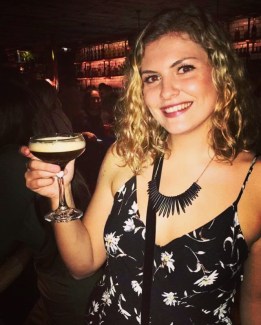
So the picture with this article is me at a full moon party on Koh Phangyan in Thailand a couple of years ago! I try and only use my own pictures on my blog, and this was the closest I could find that has anything to do with being promiscuous haha – even though it’s just a picture of me dancing! Below me pulling a funny face is my aussie friend Zan.

Are cocktails giving you brain damage?

Well yes, they are actually.

Do I still love them? Yes, they’re pretty and yummy.

This post is about increasing awareness rather than personally condemning everyone that drinks (myself included) and just hopefully inspiring people to ask a few more questions and take the issue a little bit more seriously.

One quick comment before I bombard you with scary facts: it can be really hard in life to get it all right and be healthy all the time, and I’m not saying you should be all at once, it’s a process. We’re all under so much pressure in this world already without feeling like we can’t enjoy simple pleasures and let loose every so often. It’s important to not feel deprived and to make fulfilling choices that feel good. I personally am working towards a mental state where I feel great about making the healthiest choice, and it’s a really exciting journey. I’m writing this post to inform you, and with some hope that the next time you face a choice about how much to drink, there will be a little voice in your head that thinks of your liver and says, ‘ooh maybe I shouldn’t have that 3rd shot of tequila’.

Alcohol is, unfortunately, one of the biggest killers in the world, sorry, but it’s true. Alcohol abuse is embedded into our society to such an extent that most people wouldn’t go to social occasions or music events etc. if they weren’t going to drink. Decreased inhibitions, questionable decisions and ‘hilarious’ displays of clumsiness (aka your brain shutting down) seem to be the only way that we can go out, enjoy ourselves and fit in.

I am by no means tee-total or have any desire to become so while I’m still at university, but it’s something I’d really like to be by the time I’m 30 – I figure/hope that most of the damage can be undone (or at least slightly repaired) while I’m still young. And yes, 30 is still young.

I’m writing a Lab Report on the ‘Effects of Ethanol on Performance’ and subsequently have done a lot of research to find out what exactly ethanol does when it enters our body. My research has included reading other lab reports, medical reviews and reports done by the World Health Organisation and Public Health England, and also stuff I learn at Uni.

The first thing that shocked me was the amount of evidence proving how bad alcohol is for you and the fact that it is a misconception that a little bit is good for you. No alcohol is good for you. Period. What’s good for you is the other nutrients in the drink e.g. antioxidants in wine, yeast in beer etc. When mainstream attitude to smoking changed around 2005/2006, the government ruled that all smoking products must have visual and written warnings of its harmful effects, but alcohol kills more people than cigarettes do! Where are the pictures showing brain damage and rotting livers on alcoholic drinks? The list of potential poor decisions and the consequences of emotional and psychological trauma. I know this has turned heavy pretty quick, but we all know someone who’s life has been ruined by alcohol.

Annually, alcohol abuse costs the total British economy £21bn and the NHS £3.5bn. If our nation was so desperate to improve the economy and save our NHS, we should have all stopped drinking, not quit one of the most successful Unions in the world. England and the USA are among the top 20 heaviest drinkers in the world and all of the top 10 countries are in Europe (Global Status Report on Alcohol and Health in 2014).

Alcohol is a Central Nervous System (CNS) depressant. Your CNS is made up of your brain and spinal cord and controls most functions in your body and mind. Ethanol (the alcoholic component of drinks) depresses the CNS; in other words, slows it down and stops it from working. Ethanol acts on various receptors in the brain in order to increase inhibitory signals and decrease excitatory signals: this results in decreased motor (movement) functions, confused thoughts, decreased awareness and poor coordination. It also interferes with your ability to lay down memories and to learn by blocking specific signalling pathways and decreasing the actions of neurotransmitters (Glutamate) in specific parts of the brain (hippocampus, amygdala and striatum). You’re all thinking, “well yes we know all that!” “I frequently wake up with no recollection of the night before.” “My friend was throwing up all night last week, it was hilarious.” Why? Why is it funny to see people poison themselves to the point where their body has to reject everything in their stomach so their organs don’t shut down?

Prolonged drinking causes irreparable damage in the brain, destroys your liver and diminishes your immune system. Short-term drinking decreases the effects of your immune system, making you much more likely to contract a virus or bacterial infection after a night out; and long-term drinking increases the immune system, causing inflammatory diseases and internal damage. Alcohol is commonly known to be bad for people with digestive disorders including IBS and interferes with a lot of medications.

Quick fact: the reason people with less body fat get drunk quicker is because alcohol is very soluble in water but not soluble in fat. So if you have more fat cells in your body, alcohol is less likely to pass out of your blood, and will head straight to the liver to get broken down. It also makes sense that if you’re a bigger/taller person, there’s more blood for alcohol to get absorbed into, thus the concentration of ethanol at any one point in your body will be less.

I understand that it is very important for people to belong in their society and to fit in with cultural norms, evolutionary speaking this was essential for our survival, and social drinking is a part of that. I’m not writing this to try and convince everybody to stop drinking and boycott all bars and nightclubs, I’m writing this just to draw your attention to it. The next time your friend chooses not to drink on a night out, respect that decision. If you see your friend about to cross the line between drunk and smashed, give them a glass of water. Value yourself sober. Your sober self is good enough, fun enough and happy enough. And if you turn to drink to escape life, have a good look at what you’re escaping from and try and fix that instead, rather than just forgetting it for a night.

img_5118
Albert Schloss Espresso Martini

I am a big believer in moderation, balance and self-awareness. Doing what works for you is the most important thing, and it’s vital that you pay attention to yourself and your body so that you can recognise if and when drinking becomes a real problem in your life. Drink to enjoy, not to forget.

My last message will be this:

Be safe, be aware, be kind to yourself and to others.